

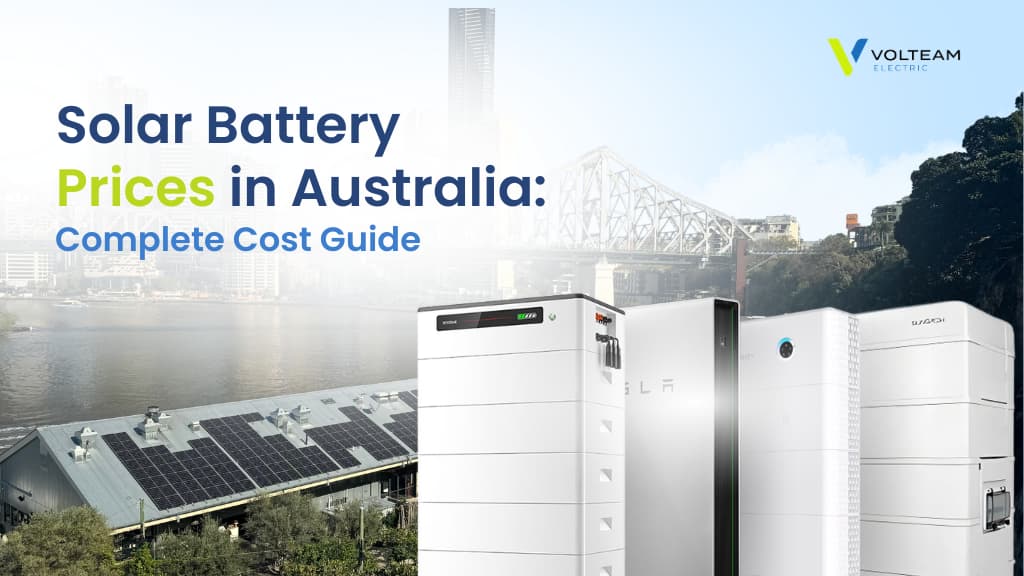
Solar Battery Prices in Australia: Complete Cost Guide
If your power bill keeps climbing while your feed-in tariff shrinks, a solar battery is the next logical step. The problem is working out what one actually costs before you talk to anyone. Prices move with battery size, brand, and the solar setup you already have, so a single sticker price rarely tells the full story.
This guide breaks down current solar battery prices in Australia for 2026, by size, by brand, and as a solar-and-battery package. Every figure below is an installed estimate that will vary with your home, your existing system, and the brand you choose. Treat them as planning ranges, then confirm the exact number on an itemised quote.
For Brisbane and South East Queensland homes and businesses, Volteam installs CEC-accredited battery systems and handles the federal rebate paperwork as an upfront discount, so the price you plan for is closer to the price you pay.
How Much Do Solar Batteries Cost in Australia? (2026)
In 2026, a home solar battery in Australia typically costs $7,500 to $17,000 installed, or roughly $600 to $1,000 per usable kWh. After the federal Cheaper Home Batteries Program rebate of around 30 percent, most households pay closer to $5,500 to $12,000. Your final price depends on battery size, brand, and how battery-ready your current solar setup already is.
That range is wide for a reason. A small 5kWh unit added to a battery-ready hybrid system sits at the bottom end. A 20kWh setup with a new battery inverter and a switchboard upgrade sits near the top. The table below shows the quick picture before and after the rebate.
| System size | Approx. installed price | Approx. after rebate |
| 5–6.5 kWh (small home) | $5,500 – $8,500 | $4,000 – $6,500 |
| 10 kWh (family home) | $8,500 – $12,000 | $6,500 – $9,500 |
| 20 kWh (large home) | $15,000 – $23,000 | $11,500 – $18,000 |
| 30 kWh+ (commercial / large-scale) | $24,000 – $40,000+ | $18,000 – $32,000+ |
Approx. only, will vary by brand, site, and install complexity. After-rebate figures assume the Cheaper Home Batteries Program discount and will move with the STC price. Confirm the exact amount on your quote.
Solar Battery Prices by Size (2026)
Size is the biggest single driver of price. Bigger batteries store more energy and cost more, but the price per usable kWh often improves as you scale up. Here is how the main size bands break down.
Small Battery (5–6.5 kWh)
A small battery suits a modest household that wants to cover evening usage and a little overnight backup. Expect $5,500 to $8,500 installed, or about $4,000 to $6,500 after the rebate. This size works best when your existing solar already has a battery-ready hybrid inverter, since you avoid the extra cost of an inverter upgrade.
Family Battery (10 kWh)
A 10kWh battery is the popular choice for an average Brisbane family running a fridge, aircon, and a few high-draw appliances into the evening. The 10kW solar battery price lands at roughly $8,500 to $12,000 installed, or about $6,500 to $9,500 after the rebate. If your home needs an AC-coupled retrofit or a new battery inverter, expect the upper end of that range.
Large Battery (20 kWh)
A 20kWh system covers a large home with high consumption, an EV, or a desire to run through most of a blackout. The 20kW solar battery price sits at around $15,000 to $23,000 installed, or about $11,500 to $18,000 after the rebate. Many of these builds use two stacked battery modules or a modular system you can expand later.
Commercial / Large-Scale Battery (30 kWh+)
For a small business or a large property, 30kWh and up moves into commercial territory. Pricing starts near $24,000 and runs past $40,000 depending on capacity, three-phase requirements, and backup design. For a full breakdown at this scale, see our 30kW solar battery price guide. You can also match the battery to a larger array on our solar panel installation page.
Get a free battery quote with Volteam. We size the system to your actual usage, not a generic template. Request your quote or call 1300 865 832.
Solar Battery Prices by Brand (2026 Comparison)
Brand changes the price as much as size does. Chemistry, warranty, and how the battery couples with your inverter all shift the installed cost. The table below compares eight of the most common batteries sold in Australia in 2026. Capacities and specs should be confirmed on each brand’s official website, since model line-ups change.
| Brand / model | Usable capacity | Chemistry | Approx. installed | Approx. $/usable kWh |
| Tesla Powerwall 3 | 13.5 kWh | LFP | $13,500 – $16,500 | $1,000 – $1,220 |
| Sungrow SBR / SBH | 9.6 – 25.6 kWh (modular) | LFP | $8,000 – $18,000 | $660 – $850 |
| BYD Battery-Box Premium | 5 – 22 kWh (modular) | LFP | $7,000 – $16,000 | $800 – $1,000 |
| LG RESU | 10 – 16 kWh | NMC | $9,500 – $14,500 | $900 – $1,100 |
| AlphaESS SMILE | 5 – 30 kWh (modular) | LFP | $6,500 – $16,000 | $750 – $1,000 |
| FoxESS | 5 – 20 kWh (modular) | LFP | $6,000 – $14,000 | $700 – $950 |
| Sigenergy SigenStor | 5 – 48 kWh (modular) | LFP | $8,500 – $20,000 | $850 – $1,100 |
| GoodWe Lynx Home | 6 – 32 kWh (modular) | LFP | $6,500 – $16,000 | $750 – $1,000 |
Approx. installed estimates, will vary by configuration and site. Specs and current model availability should be verified on each brand’s official site. Volteam does not publish fixed product prices. The figures above are market planning ranges, not Volteam price lists.
A few patterns stand out. LFP (lithium iron phosphate) dominates the 2026 market for its long cycle life and safety. Modular systems from Sungrow, AlphaESS, FoxESS, Sigenergy, and GoodWe let you start smaller and add capacity later. Tesla’s Powerwall 3 carries an integrated inverter, which can simplify the install on the right home.
Price is only half the brand decision. Warranty terms, supported cycle life, and how well the battery pairs with your inverter all affect long-term value. Most of the brands above warrant their batteries for around 10 years, but the fine print differs on retained capacity and cycle count. A slightly dearer battery with a stronger warranty and local support often costs less over its life than the cheapest unit on paper. We walk you through those trade-offs against your actual usage rather than pushing a single brand.
For a closer look at two of these, see our LG solar battery price guide and our Sungrow solar battery price guide. You can also browse the full range of batteries Volteam installs on the solar batteries Brisbane page.
Solar + Battery Package Prices (Bundle vs Retrofit)
If you are buying solar and a battery together, a package usually works out cheaper per kilowatt than buying each separately. A combined install shares the same site visit, switchboard work, and labour, so the solar and battery price drops compared with two separate jobs.
There are two ways to get there:
- New solar-plus-battery bundle. A fresh system with a hybrid inverter built in from day one. This avoids paying twice for inverter work later.
- Battery retrofit. Adding a battery to existing solar. If your current inverter is not battery-ready, you will need an AC-coupled battery or a new hybrid inverter, which lifts the price.
| Package | Typical setup | Approx. installed |
| 6.6 kW solar + 10 kWh battery | New bundle, hybrid inverter | $14,000 – $19,000 |
| 10 kW solar + 13.5 kWh battery | New bundle, hybrid inverter | $18,000 – $25,000 |
| Battery retrofit to existing solar | Add 10 kWh, AC-coupled or new inverter | $9,500 – $13,500 |
Approx. only, before rebate. Package pricing varies with panel brand, inverter, and roof complexity.
The cheapest path is almost always to size the solar and battery together so the system covers your evening and overnight load without overbuilding. A new bundle also keeps the solar power battery price lower per kWh than a staged approach. For the panel side of the build, start with solar panel installation, and if you are weighing a system size, the 10kW solar system page is a useful reference.
What Affects the Price of a Solar Battery?
Two homes can get very different quotes for the same battery. These are the factors that move the number up or down.
Chemistry and Capacity
Usable capacity, measured in kWh, sets the baseline cost. Chemistry matters too. LFP batteries cost a little more upfront than older NMC packs but tend to last longer and run cooler, which is why most 2026 models use them. If a term like usable kWh or depth of discharge is new to you, our solar glossary explains the basics in plain language.
Inverter Setup (AC-Coupled vs DC-Coupled)
This is the factor people forget. The cheapest path is a DC-coupled setup, where your solar already runs a battery-ready hybrid inverter and the battery slots straight in. If your inverter is not battery-ready, you have two options: replace it with a new hybrid inverter, or add an AC-coupled battery that brings its own inverter. Either route can add $1,500 to $3,500 to the job. AC-coupling is often the easier retrofit for an existing system, while DC-coupling tends to be more efficient and cheaper when you install solar and a battery together. You can see the inverter options Volteam works with on the inverters page.
Single-Phase vs Three-Phase Power
A three-phase home can need extra equipment to deliver backup across all phases, adding roughly $500 to $1,500 to the job.
Switchboard Upgrades
Older switchboards often need an upgrade to meet current standards and safely connect a battery. Budget an extra $800 to $2,500 if yours is dated.
Backup Capability
Whole-home backup costs more than essential-circuit backup, because it needs a gateway and more wiring. Decide which circuits you actually need on during an outage, since covering everything raises the price.
Install Complexity
Roof access, cable runs, wall space, and how far the battery sits from the switchboard all affect labour. A clean, simple install is cheaper than one that needs long cable runs or tricky access.
Talk to a CEC-accredited installer. Volteam is QLD Electrical Licence #72286 and Clean Energy Council accredited, with 5,000+ Brisbane homes and 10,000+ installations behind us. Call 1300 865 832 or request a quote.
The Cheaper Home Batteries Rebate: How Much You Save
The federal Cheaper Home Batteries Program is the main reason 2026 is a strong year to buy. It cuts around 30 percent off the upfront cost of an eligible battery, delivered through Small-scale Technology Certificates (STCs) under the Small-scale Renewable Energy Scheme. You can read the official details on the Australian Government energy website.
Here is what matters for your price:
- Around 30 percent off the upfront cost, applied as a discount rather than a later refund.
- Eligible battery size of 5 to 100 kWh, with the first 50 kWh of a system counting toward support.
- Tiered from 1 May 2026, so the per-kWh support moderates for medium and large batteries to track falling costs. The discount still works out near 30 percent across sizes.
- Declines each year toward 2030, which is why waiting tends to cost more, not less.
The exact dollar figure floats with the STC price, so confirm it on your itemised quote rather than relying on a fixed number. Volteam handles the STC trade-in for you as an upfront invoice discount, so you do not need to register or sell certificates yourself. For full eligibility and the current tier, see the Cheaper Home Batteries Program page.
Most of the discount comes from this single federal program. Some states add their own battery rebates or interest-free loans on top, so total support varies by location. In Queensland, the federal rebate is the main lever right now, so Brisbane and South East Queensland buyers can treat it as the baseline and check for any current state offer at the time of install. Volteam confirms exactly what applies to your address on the quote.
Are Solar Batteries Worth It in 2026?
For most homes that already export cheap solar at a low feed-in tariff, the answer is yes. A battery lets you store your own daytime power and use it at night instead of buying it back at peak rates. The payback depends on your usage, your tariff, and if you join a Virtual Power Plant (VPP).
| System | Approx. annual bill saving | Typical payback (after rebate) |
| 10 kWh family battery | $1,200 – $1,800 | 6 – 9 years |
| 20 kWh large home | $2,000 – $3,000 | 6 – 9 years |
| 30 kWh+ small business | $3,500 – $6,000 | 5 – 8 years |
Approx. only. Savings depend on usage, tariff, solar size, and VPP participation.
A VPP can add income on top. By letting your retailer draw on your battery during peak demand, you can earn credits or payments that shorten the payback further. Volteam can advise which VPP options suit your battery and tariff.
There is value a payback table never captures, too. A battery keeps your lights, fridge, and internet running through a blackout, which matters during the storm season across South East Queensland. It also locks in protection against the next round of electricity price rises, since power you store from your own roof costs nothing extra when grid rates climb. For many households, that mix of bill savings, backup, and price certainty is what tips the decision.
Case Study: A Family 10 kWh Battery
A four-person Brisbane household with 6.6 kW of solar was exporting most of its daytime generation at a low feed-in rate, then buying power back at peak in the evening. Adding a 10 kWh battery let them store the midday surplus and run the evening load from stored solar. Their estimated annual saving landed near $1,500, with payback inside the 6 to 9 year band after the rebate. Figures vary by household. This is an illustrative example, not a guarantee.
Case Study: A Small-Business 30 kWh Battery
A small commercial site with high daytime and early-evening demand paired a larger array with a 30 kWh battery. Storing solar for the late-afternoon peak cut the most expensive grid draw of the day. The estimated saving sat in the $3,500 to $6,000 range, with a shorter payback than a typical home because commercial usage lines up well with stored solar. As always, the real number depends on the site’s load profile.
How to Get the Best Solar Battery Price
A lower price comes from smart choices, not from chasing the cheapest possible hardware. Use these steps to get value without cutting corners.
- Get quotes from a CEC-accredited installer. Accreditation is required for the rebate and signals a compliant, warrantied install. Cheap, non-accredited work can void the rebate and the warranty.
- Right-size the battery to your usage. Buying more capacity than your evening and overnight load needs wastes money. A proper usage assessment beats guessing.
- Bundle solar and battery where you can. A combined install shares labour and switchboard work, lowering the cost per kWh.
- Check your inverter first. A battery-ready hybrid inverter avoids a costly upgrade. If yours is old, factor that in early.
- Confirm the rebate on the quote. Make sure the Cheaper Home Batteries discount is itemised so you can see the real net price.
- Compare on installed price, not hardware alone. Two quotes for the same battery can differ by thousands once install scope is included.
Volteam backs its pricing with a 30-Day Price Beat Guarantee, so if you find a comparable quote cheaper within 30 days, we will beat it. Want to see your numbers first? Use the solar savings calculator to estimate your potential savings, then request a quote.
Frequently Asked Questions
How much does a 10kWh solar battery cost in Australia?
A 10kWh solar battery costs roughly $8,500 to $12,000 installed in 2026, or about $6,500 to $9,500 after the Cheaper Home Batteries Program rebate. The exact price depends on the brand and on your inverter. If your solar already has a battery-ready hybrid inverter, you pay less.
How much does a 20kWh solar battery cost?
A 20kWh solar battery typically costs $15,000 to $23,000 installed, or about $11,500 to $18,000 after the rebate. Many 20kWh builds use stacked or modular batteries, and three-phase or backup requirements can raise the price.
Is the solar battery rebate still available in 2026?
Yes. The federal Cheaper Home Batteries Program is active in 2026 and cuts around 30 percent off an eligible battery. The support is tiered from 1 May 2026 and declines each year toward 2030, so the discount is largest the sooner you install.
How long do solar batteries last?
Most modern LFP solar batteries are warranted for around 10 years and are built to last well beyond that with normal use. Warranty terms vary by brand, so check the cycle and capacity warranty on the model you choose.
Can I add a battery to my existing solar system?
Yes. If your inverter is battery-ready, a retrofit is simple and cheaper. If it is not, you will need an AC-coupled battery or a new hybrid inverter, which adds to the cost. Volteam can retrofit a battery regardless of who installed your original solar.
What is the cheapest solar battery in Australia?
The lowest installed cost usually comes from a smaller modular battery (around 5 to 6.5 kWh) added to a battery-ready system, often from $5,500 before the rebate. The cheapest option per usable kWh is generally a larger modular system, where the price per kWh drops as capacity rises.
Are solar battery prices going up or down in 2026?
Hardware prices have been easing as global battery production scales, and the cost per usable kWh keeps trending down. The catch is the rebate. The Cheaper Home Batteries Program support steps down each year toward 2030, so the net price you pay is more likely to rise than fall as the discount shrinks. For most buyers, that makes 2026 a strong year to install.
Conclusion
Solar battery prices in Australia in 2026 run from about $5,500 for a small unit to $40,000 or more for a commercial system, with most homes landing between $7,500 and $17,000 installed before the rebate. Size, brand, and your existing inverter set the price, and the Cheaper Home Batteries Program takes roughly 30 percent off the top.
The smartest move is to size the battery to your real usage, bundle it with solar where possible, and use a CEC-accredited installer who itemises the rebate. That is how you store your own solar, slash your bills, and move toward real energy independence.
Ready to see your price? Get a free battery quote with Volteam, call 1300 865 832, or estimate your savings first. QLD Electrical Licence #72286 · ABN 44 144 945 424 · CEC accredited · 5.0 on Google.