

LG Solar Battery Price: Full Cost Breakdown, Specs & Installation Guide
LG Energy Solution has supplied battery cells to the likes of Hyundai and Ford for years, so it’s that same technology you’re getting as a homeowner with their RESU range.
If you’ve been quoted an LG RESU battery – or you’re simply trying to work out whether LG is the right call – this guide covers:
- Every model
- What each one costs to install
- Inverter compatibility
- Available discounts and rebates
The prices we’re covering here are current estimates since the specific costs are always going to vary depending on the installation, so we’d always recommend getting a personalised quote through Volteam before committing.
The good news on cost, though, is that LG RESU batteries are eligible for the federal Cheaper Home Batteries Program, which takes approximately 30% off your upfront installation cost. More on that below – but the short version is that the rebate is higher now than it will be in 12 months.
What Is the LG Solar Battery?
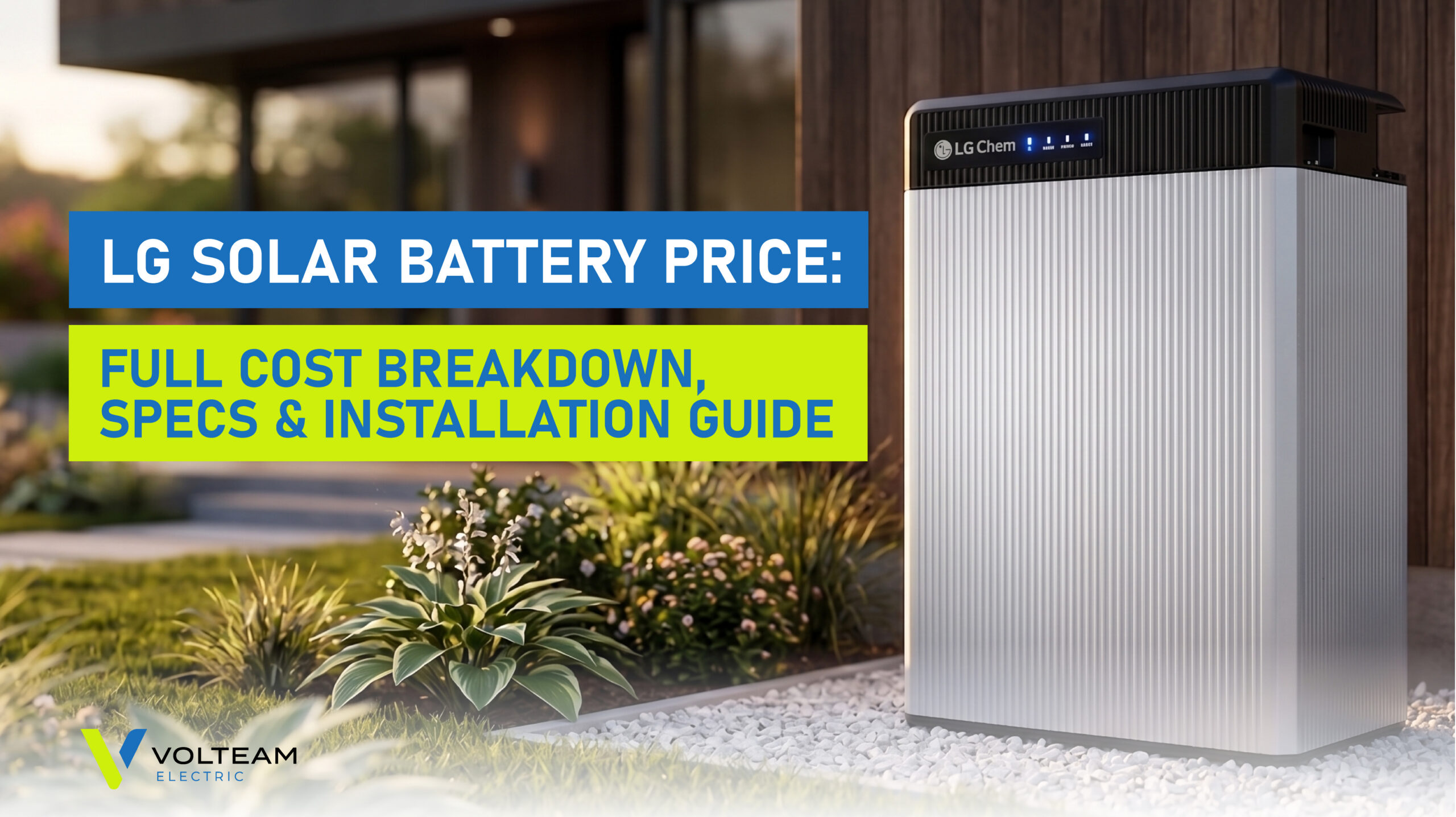
The LG solar battery range is called RESU (Residential Energy Storage Unit) – they’re available in capacities from 9.6 kWh to 16 kWh per unit, and we’d recommend them for storing your solar energy from the day to use in the night or during blackouts.
It’s also worth knowing here that LG did a safety recall in September 2022 of certain residential batteries with cells manufactured between the 29th of March 2017 and the 13th of September 2018.
This affected older RESU units. Not the current RESU Prime range. It’s not a concern if you’re buying new, but check the ACCC Product Safety recall notice to see whether your unit is affected if you own an older LG Chem RESU.
Also, LG no longer manufactures solar panels – they’ve been all about batteries since about the same time as that recall, which is good for you since the RESU range now gets the full engineering attention.
LG Solar Battery Models – Full Range Overview
There are four main models LG currently make – let’s take a look. Here’s the full specification breakdown:
| Model | Usable Capacity | Voltage | Chemistry | Cont. Power | Peak Power | Warranty | Mount |
| RESU10H Prime | 9.6 kWh | 400V (HV) | NMC | 5 kW | 7 kW | 10 yr / 70% | Wall or Floor |
| RESU16H Prime | 16 kWh | 400V (HV) | NMC | 7 kW | 11 kW | 10 yr / 70% | Floor |
| RESU12 (LV) | 11.7 kWh | 48V (LV) | NMC | 4.2 kW | 5 kW | 10 yr / 70% | Wall or Floor |
| RESU Flex (per unit) | 8.6-17.2 kWh | HV modular | NMC | 4.3-8.5 kW | 5-11 kW | 10 yr | Floor |
Whether or not your battery is HV or LV is what determines the inverters you can pair with, which in turn affects your total installation cost. For example, the RESU10H Prime and RESU16H Prime are 400V high-voltage systems, whereas the RESU12 runs at 48V low-voltage and works with a broader range of hybrid inverters.
Fortunately, you can stack on both HV models: two RESU16H Primes would give you 32 kWh, for instance.
Also, you’ll be glad to know that all the RESU Prime models come with an IP55 weatherproof rating, which means they’re suitable for both indoor and outdoor installation in Australia.
LG Solar Battery Price – Full Cost Breakdown
Now, as for the price, these batteries are definitely around the mid-to-premium end of the market. They cost more per usable kWh than LFP alternatives like BYD or Sungrow, but you are getting great inverter compatibility in specific setups.
This is roughly what you can expect to pay right now:
| Model | Hardware Only (AUD) | Installed Incl. Inverter (AUD) | After ~30% Rebate (AUD) | Cost per kWh (Installed) |
| RESU10H Prime (9.6 kWh) | $7,500 – $9,500 | $9,500 – $14,000 | $7,000 – $10,500 | ~$990 – $1,460/kWh |
| RESU16H Prime (16 kWh) | $12,000 – $14,500 | $14,000 – $20,000 | $10,000 – $14,500 | ~$875 – $1,250/kWh |
| RESU12 LV (11.7 kWh) | $8,500 – $10,000 | $11,000 – $15,500 | $8,000 – $11,000 | ~$940 – $1,325/kWh |
| RESU16H Prime x2 (32 kWh) | $24,000 – $29,000 | $27,000 – $38,000 | $19,500 – $27,500 | ~$844 – $1,188/kWh |
What Brings the Cost Up or Down?
- Inverter Situation: You avoid the highest variable cost if your existing inverter is already compatible with LG RESU. You’d need to add about $1,500-$3,500 to your budget, however, if you need a new hybrid inverter. Depending on the brand and capacity, of course.
- Single-Phase vs Three-Phase: Three-phase installations are more complex, which means higher labour costs. Factor in an additional $500-$1,500 compared to single-phase if your property runs three-phase power.
- Switchboard Upgrade: Older switchboards usually need upgrading before a battery can be safely added. Budget $800-$2,500 if your installer flags this.
- Stacked Systems: Two RESU16H Primes installed together won’t cost exactly twice a single unit. Some installation work – switchboard assessment, grid approval, commissioning – only needs to be done once. Regardless of how many batteries you’re installing.
Get a Free LG RESU Battery Quote from Volteam!
How the Cheaper Home Batteries Rebate Applies to LG Systems
The federal Cheaper Home Batteries Program gives you about a 30% discount upfront on eligible battery installations. LG RESU batteries – all models – are eligible, provided your system is:
- CEC-listed
- Installed by a Solar Accreditation Australia (SAA) accredited installer – like Volteam
- Paired with a new or existing solar PV system
This discount mechanism works through Small-scale Technology Certificates (STCs). You never receive a cheque or apply separately – your installer just gives you a reduced invoice. The rebate is assigned to the installer, and the savings are applied directly to your cost at the time of purchase.
It’s worth noting, however, that the government adjusted the STC Factor structure again on the 1st of May 2026. So, the full STC Factor still applies for batteries up to 14 kWh. For capacities between 14 and 28 kWh, though, the factor applies at 60%, and it’s 15% for capacities above 28 kWh.
This means the RESU10H Prime (9.6 kWh) would get the full rebate – roughly $3,000 off hardware costs. The RESU16H Prime (16 kWh) gets the full rate on the first 14 kWh and 60% on the remaining 2 kWh – still a meaningful saving, but slightly reduced compared to pre-May 2026 rates.
Now, the STC rebate decreases annually until 2030, so while the factor is 6.8 STCs per kWh right now, it’ll be stepping down to 2.1 by 2030. So waiting 12 months from now means a smaller discount
LG Battery Inverter Compatibility
Inverter compatibility is the single factor that determines whether LG RESU is the right battery or an expensive mismatch. You’re looking at high extra costs that weren’t in your original quote if you get this wrong.
| Your Existing Inverter | Compatible LG Model | Notes |
| SolarEdge (StorEdge / Energy Hub) | RESU10H Prime, RESU16H Prime | Best-in-class pairing. DC-coupled. Strong monitoring integration with SolarEdge Energy Hub. |
| SMA Sunny Boy | RESU10H Prime, RESU16H Prime | AC-coupled via SMA Sunny Boy Storage. |
| Sungrow Hybrid (SH series) | RESU12 (LV) | 48V LV model only. HV RESU not compatible with Sungrow hybrid. |
| GoodWe Hybrid | RESU12 (LV) | 48V LV model. We’d suggest verifying the current firmware compatibility before you buy. |
| Fronius GEN24 | RESU16H Prime (verify) | HV compatibility – confirm on the CEC-approved list before quoting. |
| Selectronic SP PRO | RESU12 (LV) | Via CAN2.0B. Strong off-grid/hybrid use case. |
| Standard string inverter (no hybrid) | Neither – new hybrid inverter required | Budget for inverter replacement or an AC-coupled solution. |
As we’ve used both terms here a lot, remember that DC-coupled means that the battery connects directly to the solar DC circuit – this is what happens with SolarEdge + LG RESU. Energy flows through one conversion instead of two, which is more efficient!
AC-coupled, on the other hand, means that your battery sits on the AC side of the system, which, while it works with a broader range of existing inverters, involves slightly more energy loss in the conversion process.
Neither of these approaches is inherently better than the other, but if you already have a SolarEdge system, the DC-coupled LG RESU pairing would be one of the best setups available in the market.
Always verify current CEC-approved pairings with your installer before signing anything – we can do this for you at Volteam.
LG Battery Installation Guide – What to Expect
Installing a battery is hardly a weekend project. LG requires CEC-accredited installers who are specifically certified for LG Energy Solution RESU products, so not every solar installer is going to qualify for this. Here’s the process from quote to commissioning.
Step 1 – Choose a CEC-Accredited, LG-Certified Installer
Your installer needs to be accredited by Solar Accreditation Australia (SAA) and certified to install LG RESU products specifically, which our team at Volteam is.
Step 2 – Confirm Inverter Compatibility
Your installer will need to see whether or not your current inverter supports RESU directly or if it needs to be upgraded to a hybrid model. It might even turn out that an AC-coupled solution makes more sense.
Step 3 – Site Assessment and Battery Location
RESU Prime batteries are IP55-rated for indoor or outdoor installation, but keep in mind that the RESU16H Prime is floor-mount only. The RESU10H Prime and RESU12, however, can be either wall or floor-mounted.
You will need at least 200mm of space on the top and the sides for ventilation, though, so be wary of this if your installation space is tight.
Step 4 – Switchboard Check
The installer will need to assess whether your switchboard can safely support the battery. You can expect to add around $800-$2,500 to your total cost if an upgrade is needed!
Step 5 – Network Approval
Battery systems above 10 kWh typically require approval from your electricity network (Ausgrid, Powercor, SA Power Networks, etc.). Your installer manages this application, but allow 2-4 weeks in some states.
Step 6 – Physical Installation
Most residential installs take one to two days. The RESU16H Prime weighs about 75 kg, so it’s obviously a two-person job. The RESU10H Prime is also approximately 52 kg.
Step 7 – Commissioning and Monitoring Setup
Your installer configures charging schedules and export settings, as well as your monitoring platform. There used to be a RESU Monitor app that was discontinued at the end of 2024, but it’s been replaced by the enblock Manager app, which has all the same monitoring tools! Confirm your installer sets this up before they leave.