

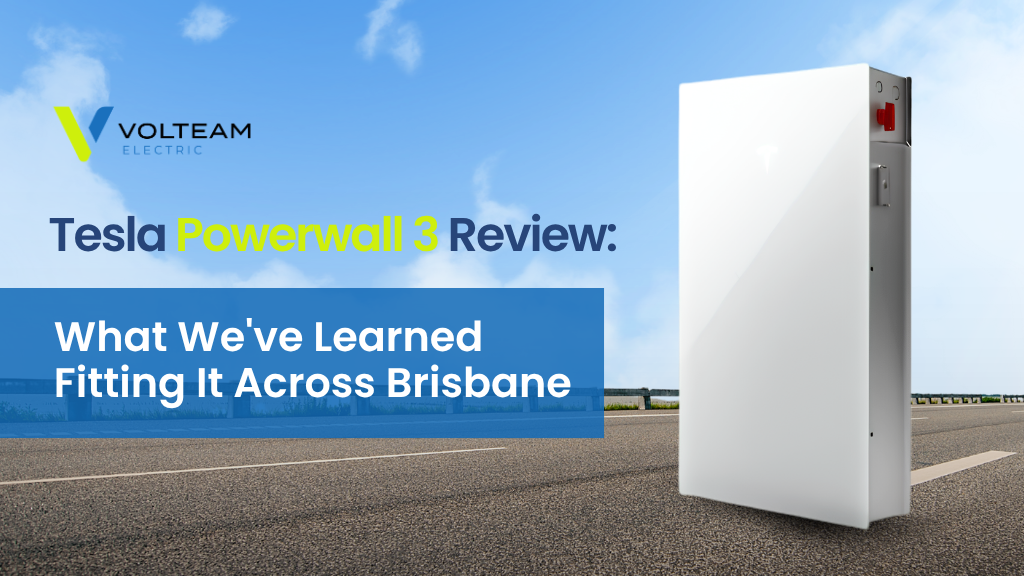
Tesla Powerwall 3 Review: What We’ve Learned Fitting It Across Brisbane 2026
The Tesla Powerwall 3 is a solar battery with the inverter built into the same box. It’s Tesla’s attempt at making a home battery simpler to install and own.
But is it worth it?
We’ve mounted enough of them on Brisbane walls to have opinions that go beyond the datasheet, and this review is written to be honest about where it earns the reputation and where it doesn’t, with the kind of install-day detail you only get from the people actually fitting it, not from reading a datasheet alone.
Below is what it actually is, who it suits, what installing one looks like, and what we’ve genuinely noticed on the job.
Tesla Powerwall 3: Key Facts at a Glance
- It suits households already on solar who want to use more of what their panels generate, and anyone who wants real backup power through a blackout rather than a generator.
- The battery and the inverter share one enclosure, which changes how it’s installed.
- Two efficiency figures appear on Tesla’s own spec sheet: 97.5% for power your panels make and your home uses immediately, and 89% for power that’s stored first and used later.
- The 185A locked rotor amp rating decides whether a ducted air conditioner’s compressor starts on battery power, not the kW figure most people focus on.
- The cells are LFP, which can handle daily cycling without the thermal runaway that older lithium formats were prone to.
- Storm Watch reads Tesla’s own weather feed and tops the battery up on its own before bad weather arrives.
- The unit needs an internet connection to receive firmware updates that matter for its full warranty support.
What Is the Tesla Powerwall 3?
The Powerwall 3 is Tesla’s third-generation home battery, and the first to house the solar inverter inside the battery unit itself rather than as a separate box. It replaces the Powerwall 2, which needed its own external inverter, and it’s the only Powerwall model Tesla currently sells in Australia. Most households add one to store daytime solar for use at night, or to keep the essentials running through an outage.
Who is the Tesla Powerwall 3 best for?
It’s not for every household. Here’s who gets the most out of one:
- Households already running solar who want to use more of what their panels generate, instead of exporting it to the grid for a low feed-in tariff.
- Anyone who’s lost the fridge and the router in a blackout and wants genuine backup power without running a generator.
- Homes with three-phase power or heavy appliances like a pool pump or ducted air conditioning, where the 185A motor-start rating matters more than the headline kW output.
What’s Inside a Tesla Powerwall 3?
The Tesla Powerwall 3 keeps the battery and the inverter in one enclosure. It’s a neat space-saving design that converts direct current (DC) from your solar panels into the alternating current (AC) your home actually uses, without a second piece of equipment in the chain. The result is one of the best efficiency ratings we see on site: 97.5%.
But there’s a catch, and it only tells half the story. That figure is for the power your panels make and your home uses immediately, not for the power you’ve stored to use later. Every battery loses some energy converting DC to AC and back again, so what you actually get back from stored solar is closer to 89%, not 97.5%.
The cells themselves are Lithium Iron Phosphate (LFP), the same chemistry family now standard across most quality batteries sold in Australia. We’ve watched this shift happen over the years we’ve been installing batteries. Older lithium chemistries hold slightly more energy for the same physical size, but LFP tolerates the deep, daily cycling a solar battery goes through and Queensland’s summer heat without the thermal runaway risk. It’s a process used by Tesla and most solar battery manufacturers.
How Easy (and Quick) Is It to Install?
Most Powerwall 3 installs are a one-day job, and the built-in inverter is a big part of why. With a separate battery and inverter, we’d be running conduit to two enclosures instead of one, which is often the difference between finishing in a day and needing a second visit, especially on a tight side passage or a garage with limited wall space.
The unit itself weighs 130kg, so it’s always a two-person lift onto the wall bracket or floor stand, and we plan for that before we arrive, rather than finding out on the day. The real decisions get made at the site visit, not on install day: wall or floor mounting depending on your space, where the Backup Gateway sits relative to your switchboard, and which circuits get wired through to backup power versus left on grid-only.
That last one is worth asking about before you buy. The Powerwall 3 can run a home more or less as normal during an outage, but only if your switchboard is wired to pass that power through. Some older switchboards need an upgrade first, and that’s a cost and timeline question we’d rather flag at the quote stage than discover on install day.
Tesla Powerwall 3 Best Features
A few things stand out once you’re actually living with one, not just installing it:
Storm Watch charges before bad weather hits
The unit watches the same weather feeds Tesla uses to predict grid strain, and tops up the battery on its own once a severe weather warning is issued nearby, well before the wind picks up. There’s no setting to remember to switch on.
The app does more than show a battery percentage
Time-based control can buy cheap grid power overnight if your plan has one, and hold your stored solar for the expensive afternoon block instead of draining it first thing. It’s worth checking the setting actually matches your electricity plan rather than leaving it on default.
One thing worth checking before you buy: your Wi-Fi signal
Tesla ties full warranty support to the unit staying connected to the internet for firmware updates. Go offline for an extended stretch and the guaranteed portion of the ten-year term drops. Check your signal at the planned mounting location before install day, not after.
How Much is a Tesla Powerwall 3? And is it Worth the Price?
The exact numbers live on our Powerwall 3 product page and move with rebates, so we won’t print them here. What’s worth knowing before you get a quote is how it’s priced next to the other batteries we install.
It comes in a one-wall or floor-mount bracket that suits most Brisbane homes without extra structural work, and it sits in the premium bracket of the batteries we install, alongside Sigenergy’s SigenStor, and above mid-tier options like GoodWe’s ESA series or Sungrow’s SBR.
It suits households who want one trusted brand handling both the battery and the inverter, and who value Tesla’s app and support network enough to pay for it. If a lower entry price matters more than the Tesla name, our Sungrow vs Tesla comparison is worth reading before you decide.
Tesla Powerwall 3 Specifications
| Spec | Detail |
| Cell chemistry | LFP (lithium iron phosphate) |
| Usable capacity | 13.5kWh |
| Nominal output | 5kW, 10kW, or 11.04kW by configuration |
| Motor start capability | 185 locked rotor amps |
| Solar-to-home efficiency | 97.5% |
| Solar-to-battery-to-home efficiency | 89% |
| Integrated inverter | Yes, 3 independent solar inputs, up to 20kW solar input |
| Dimensions (H x W x D) | 1,105 x 609 x 193mm |
| Weight | 130kg |
| Enclosure rating | IP55 enclosure, IP67 battery and power electronics |
| Operating temperature | -20°C to 50°C |
| Expansion | Up to 3 units, 13.5kWh each |
| Warranty | 10 years, 70% capacity retention |
How It Compares
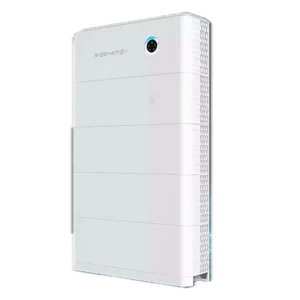
We’ve written up dedicated comparisons for the questions we get asked most on site: Sungrow against the Powerwall 3, and Sigenergy SigenStor against the Powerwall 3. If you’re weighing up the older model, the Powerwall 2 was discontinued in Australia in late 2025, and the technical difference that matters most is the inverter. Powerwall 2 needed a separate one, which is exactly what Tesla built out of the Powerwall 3.
| Product Specifications | ||
|---|---|---|
| Battery Type | Lithium Iron Phosphate (LFP) | Lithium Iron Phosphate (LFP) |
| Usable Capacity | 13.5kwH | 5–48 kWh per stack |
| Modules | N/A (Integrated system) | N/A (not explicitly defined) |
| Voltage Range | N/A | 300–600 V |
| Dimensions (HxWxD) | 1,099 x 609 x 193 mm | 270 × 767 × 260 mm |
| Efficiency | high round-trip efficiency 90% | 100 % DoD, ~98% round-trip efficiency |
| Peak Power | 5.8 kW (kilowatts), peak output of 7.6 kW | 3.75 kW |
| Weight | 130 kg | 55 kg |
| Parallel Operations | Up to 4 units | N/A |
| Nominal Power | 11.04 kW | 2.5 kW |
| Warranty | 10 years | 10-year / 9,000-cycle warranty |
| Certificates | IEC 61000-6-1: 2016, IEC 61000-6-3: 2020, IEC 62477-1: 2022, IEC 62109-1: 2010, IEC 62109-2: 2011, IEC 62933-5-2: 2020, IEC 62619: 2022, UL 1973, UL 9540A, AS 4777.2 | IEC/EN 60730-1, UN 38.3, IEC/EN 62619, IEC/EN 63056, IEC/EN 62040 |

Our Genuine Experience of the Tesla Powerwall 3
The number that surprises most customers isn’t the kW output, it’s the 185A locked rotor amp rating. That’s the surge current a motor needs to start, and it’s what actually decides whether a ducted air conditioner’s compressor, an induction cooktop, or a shed full of power tools runs on battery power without tripping the system, not the kW figure most people focus on first.
Expansion is the other question that comes up as a household’s needs grow. Up to three packs can sit behind the original unit, each adding 13.5kWh of storage. Worth knowing: an expansion pack is battery only, with no inverter of its own, so it buys you more hours of runtime rather than more surge power for motor starts. If your future plans lean toward something power-hungry rather than something that just runs longer, that’s worth knowing before you add capacity.
Volteam has fitted Powerwall 3 units across Brisbane since it launched here, and this review is built on that fieldwork, not the datasheet alone. Curious how one fits your home? Browse our solar battery installations or get a free quote.
Frequently Asked Questions
Why does Tesla publish two different efficiency numbers for the Powerwall 3?
Because they measure two different paths the power takes. Solar-to-home efficiency, 97.5%, is for power your panels make and your home uses immediately. Solar-to-battery-to-home efficiency, 89%, is for power that gets stored first and drawn down later, which loses more in the conversion. Most reviews only quote the higher number, which overstates what you actually get back overnight.
Does the Powerwall 3 need an internet connection to work?
It will run without one day to day, but Tesla’s full warranty support depends on the unit receiving firmware updates over an internet connection. Extended time offline reduces the guaranteed portion of the ten-year warranty term. Check your Wi-Fi signal at the planned mounting location before install day.
What actually changed between the Powerwall 2 and the Powerwall 3?
The biggest change is the inverter. The Powerwall 2 needed a separate solar inverter installed alongside it. The Powerwall 3 has one built in, which is why installs need less equipment and less wall space, and why the output figures on its spec sheet include configurations up to 11.04kW rather than the fixed output the Powerwall 2 offered.
Is a Tesla Powerwall 3 difficult to install?
Not difficult, but it does need planning. It’s a 130kg unit, so it’s a two-person lift onto the mounting bracket, and the real work is in the switchboard assessment beforehand, deciding which circuits carry through to backup power. We handle both at the site visit stage, ahead of the install date itself.
Can I still buy a Tesla Powerwall 2?
No, Tesla discontinued the Powerwall 2 in the Australian market in late 2025. An existing unit isn’t affected by that and carries on under whatever warranty term it was sold with. For a new install, the Powerwall 3 is the only model Tesla currently sells here, and the built-in inverter is the main reason the two aren’t interchangeable in a quote.
See Current Pricing and Rebate Detail
The cost ranges, the federal rebate breakdown, and the full pros and cons live on our Powerwall 3 product page.