

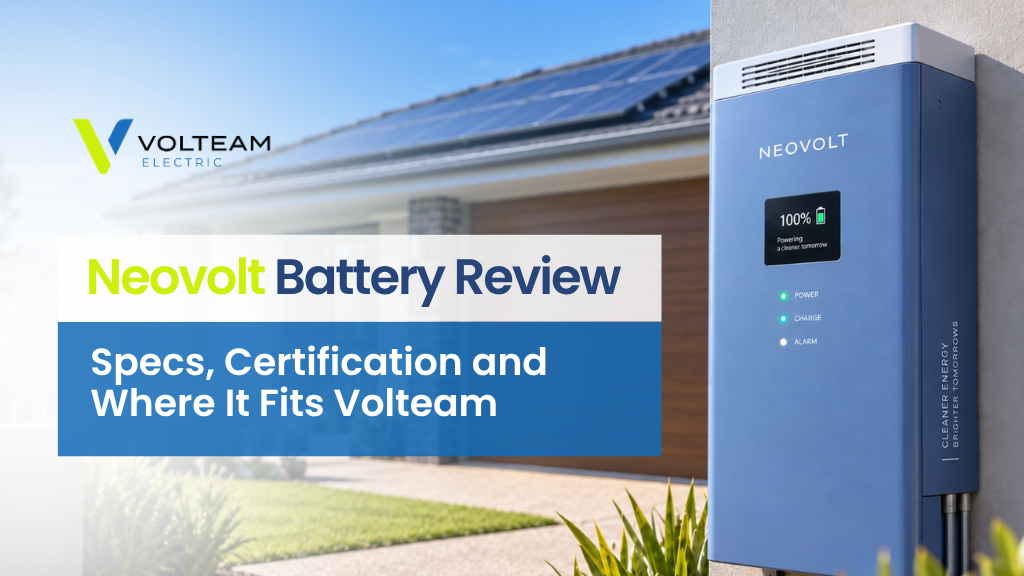
Neovolt Battery Review: Specs, Efficiency & Value
We get asked about the Neovolt battery a lot. It shows up near the top of a lot of Brisbane battery price searches, and homeowners want to know if the low sticker price stacks up against the batteries our electricians actually install and back with a warranty claim.
Here’s the honest starting point: Neovolt isn’t currently one of the brands in Volteam’s own installed range, so this isn’t a field report from our crew. It’s an independent, technical review, built from the battery’s certification records, its manufacturer’s published specifications, and how those numbers compare to the systems we do have hands-on experience with (like GoodWe, Sungrow, Tesla, Sigenergy, and Alpha ESS).
If you want a battery we install and warranty ourselves, jump straight to our solar battery installation page. If you want to understand what Neovolt actually is before you compare it against anything else, read our honest Neovolt battery review.
Neovolt Battery: Capacity, Warranty & Performance
- Neovolt is a 10.1kWh lithium iron phosphate (LFP) battery, model BW-BAT-10.1P, manufactured by Bytewatt Technology and CEC-approved for the Australian market.
- Usable capacity sits at roughly 9.6kWh, with continuous output around 3.6kW to 5kW depending on which inverter model is paired with it.
- It carries a 10-year warranty with an 80% capacity retention guarantee, broadly in line with the brands we install.
- Its IP65 rating and passive cooling suit outdoor mounting in a Queensland climate, similar to the specification most CEC-approved batteries carry.
- If your priority is a battery backed by the installer who fitted it, GoodWe, Sungrow, Tesla Powerwall 3, Sigenergy and Alpha ESS are the brands we currently supply and support.
What is the Neovolt Battery?
Neovolt is the retail name that Bytewatt Technology, a Chinese battery manufacturer, uses for its residential energy storage range in Australia. The battery itself is a lithium iron phosphate (LFP) unit, the same broad chemistry family as most of the batteries we install, chosen across the industry because LFP cells are more thermally stable than older lithium-ion chemistries and tolerate a deeper cycle life before capacity fades.
The base unit is a 10.1kWh battery, model BW-BAT-10.1P, paired with either a 3.6kW or 5kW hybrid inverter. Because the modules are designed to link in parallel, several households buy more than one unit to build up a larger bank, in the same way Sungrow’s SBR range or GoodWe’s Lynx series scale by adding modules rather than swapping the whole system.
Unlike the brands we sell, Neovolt isn’t distributed through a single Volteam-style installer network. It’s sold through a scattered mix of solar retailers and installers around the country, which is worth knowing before you compare a Neovolt quote against a quote for a battery that a business installs directly, as it could mean it’s more expensive or more difficult to access and install.
Capacity, Output and Efficiency
The numbers that matter most for day-to-day use are usable capacity and continuous output, not the headline capacity figure.
- Total capacity: 10.1kWh
- Usable capacity: approximately 9.6kWh
- Continuous output: 3.6kW or 5kW, depending on the inverter model
- Surge output: up to 10kW on the 5kW inverter model, briefly, for motor start-up loads like a pool pump or air conditioner compressor
- Roundtrip efficiency: in the high-90s (the manufacturer’s own listing puts it around 97 to 98%, which is a normal range for a modern LFP hybrid battery)
A 5kW continuous rating is enough to run a fridge, lighting, a TV and a load of washing without drawing from the grid, but it’s on the lower end if a household wants to run ducted air conditioning or charge an EV from battery power alone during an outage. That’s not a knock on Neovolt specifically. It’s the same ceiling most single-phase, single-unit residential batteries run into, including some of the entry models in the brands we install.
Certification and Safety
Before recommending any battery to a client, or reviewing one we don’t install, I check whether it’s actually CEC-listed, because that listing is what makes a battery eligible for the federal Cheaper Home Batteries Program discount and what most electrical safety inspectors will look for.
The BW-BAT-10.1P model is CEC-approved, which means it’s been assessed against the Clean Energy Council’s product requirements for the Australian market. It also carries IEC 62619 certification, the international standard for lithium battery safety in stationary storage, and a UN38.3 rating covering safe transport of lithium cells. Its enclosure is rated IP65, which means it’s sealed against dust and low-pressure water jets, a sensible rating for a unit mounted outside in Brisbane’s humidity and storm season.
None of that is unusual among CEC-approved batteries, GoodWe, Sungrow, Tesla and Sigenergy all carry comparable certification. What it does confirm is that Neovolt clears the same regulatory bar rather than sitting outside it.
Neovolt Battery Specifications
| Spec | Detail |
| Manufacturer | Bytewatt Technology Co. Ltd |
| Model | BW-BAT-10.1P |
| Chemistry | Lithium Iron Phosphate (LFP) |
| Total Capacity | 10.1 kWh |
| Usable Capacity | Approx. 9.6 kWh |
| Continuous Output | 3.6 kW or 5 kW (inverter-dependent) |
| Surge Output | Up to 10 kW (5 kW inverter model) |
| Roundtrip Efficiency | Approx. 97 to 98% |
| Cooling | Passive, no internal fans |
| Ingress Protection | IP65 |
| Dimensions | 590 x 750 x 205 mm |
| Weight | 90 kg |
| Warranty | 10 years, 80% capacity retention guarantee |
| Certification | IEC 62619, UN38.3, CEC-approved (BW-BAT-10.1P) |
Explore the Solar Batteries We Install in Brisbane
If you’d rather see the batteries Volteam actually installs and backs with our own workmanship warranty, explore the solar batteries we install and back in Brisbane.
Where a Battery Like This Fits in a Home
Specs are only useful once you translate them into a household. With roughly 9.6kWh of usable storage, a single Neovolt unit is a reasonable match for a three or four-bedroom home with moderate evening usage, enough to cover lighting, a fridge, a TV and some cooking without drawing from the grid overnight.
It starts to fall short for a household that runs ducted air conditioning through summer, charges an EV overnight, or wants enough backup to ride out an extended outage. In those cases, either a larger single-unit battery or a stacked system, which several of the brands we install support natively, is the better starting point. The same logic applies whether you’re comparing Neovolt, GoodWe, Sungrow or anything else, match the usable capacity and continuous output to what the household actually draws overnight, not to the headline kWh number on the box.
How Neovolt Compares to the Brands We Actually Install
On paper, a lot of CEC-approved LFP batteries land in a similar range on capacity and efficiency. Where they tend to separate is warranty backing, local support, and how the battery integrates with a household’s existing solar and switchboard setup, which is where installation experience actually matters.
- Sungrow SBR covers a wider capacity range through its modular design, and we install and warranty it directly. See how it stacks up in our Sungrow vs Tesla and Sungrow vs GoodWe comparisons.
- GoodWe’s ESA series combines the battery and hybrid inverter as one integrated unit, similar in concept to Neovolt’s approach, but it’s a brand we install, service and provide our own workmanship warranty on. Read our full GoodWe battery review for more detail.
- Tesla Powerwall 3 sits at a higher capacity and output tier, with a built-in inverter capable of running a full household including some EV charging load.
- Sigenergy SigenStor is worth a look if you want a battery designed from the ground up for future EV and smart-home integration.
- Alpha ESS rounds out our range as a mid-tier, well-established option with a long track record in the Australian market.
If you want a side-by-side view across more brands, our Top 10 Solar Batteries guide is a useful starting point.
Warranty, Support and What to Watch For
Neovolt’s published warranty, 10 years with an 80% capacity retention guarantee, reads the same on paper as most of the batteries we install. The difference that actually matters to a homeowner isn’t the warranty document, it’s who stands behind it if something goes wrong.
Because Neovolt is sold through a scattered mix of retailers rather than one consistent installer network, the local support experience can vary a lot more than it does with a brand we install directly, where the same business that fitted the system also handles the warranty claim. That’s not a defect in the battery itself, but it’s a genuine, practical difference worth asking about before you buy: who do you call in year six if the battery throws a fault, and how quickly do they actually turn up?
How Much is a Neovolt Battery?
The Neovolt battery cost for your property will depend entirely on which retailer or installer you buy through and what your switchboard and site require. As a general market guide, supplied and installed pricing for the base 10.1kWh unit has been publicly advertised in the roughly $7,000 to $13,000 range before any rebate, though get a firm, itemised quote from whoever you’re buying it through rather than relying on an average.
Because the BW-BAT-10.1P model is CEC-approved, it can qualify for a Cheaper Home Batteries Program discount at the point of sale, but eligibility and the exact discount depend on your installer, your system size, and your postcode. Confirm the figure with the retailer you’re dealing with rather than assuming it applies automatically.
Is a Neovolt Battery Worth It?
Neovolt clears the same certification bar as the solar batteries we install, and on paper the specs hold up. But what it doesn’t offer is a Volteam workmanship warranty or a Volteam electrician answering the phone if something needs attention in year six.
If the sticker price is the only thing that matters, it’s a legitimate CEC-approved option. But if you’d rather the business that installed the battery also stands behind it, GoodWe, Sungrow, Tesla Powerwall 3, Sigenergy and Alpha ESS are the brands we supply, install and warranty directly.
Get a free quote and we’ll size the right one for your home.
Frequently Asked Questions
Does Volteam install the Neovolt battery?
No. Neovolt isn’t currently part of our installed battery range, which is why this review is written as an independent technical assessment rather than an installer’s field report. If you want a battery we supply, install and warranty directly, our range currently includes GoodWe, Sungrow, Tesla Powerwall 3, Sigenergy and Alpha ESS.
Is the Neovolt battery CEC-approved?
Yes. The BW-BAT-10.1P model appears on the Clean Energy Council’s approved products list, which is the listing that matters for both electrical compliance and eligibility for government battery rebate programs.
Can a Neovolt battery be added to an existing solar system from a different panel brand?
Generally yes, most hybrid battery inverters, Neovolt’s included, are designed to work with a wide range of existing solar panel brands rather than being locked to one manufacturer. The detail that actually matters is whether your existing inverter setup, switchboard capacity and metering support the retrofit, which is a site-specific question for whoever quotes the installation.
How does Neovolt’s output compare to the batteries Volteam installs?
Neovolt’s continuous output tops out around 5kW on its larger inverter model, which is comparable to entry-level configurations of some brands we install but below the higher-output tiers Tesla Powerwall 3 and Sigenergy SigenStor offer. If running heavy loads like ducted air conditioning off battery power is a priority, it’s worth comparing continuous output specifically, not just total capacity.
What should I ask an installer before buying a Neovolt battery?
Beyond price, ask who handles warranty claims if the manufacturer’s local support is slow to respond, what workmanship warranty the installer offers separately from the battery’s own warranty, and whether the quoted price is genuinely supplied-and-installed or excludes switchboard and metering upgrades.
Is Neovolt worth choosing over a brand Volteam installs?
That depends on what you’re optimising for. If the lowest sticker price is the priority and you’re comfortable managing warranty support through a retailer rather than an installer, Neovolt is a legitimately CEC-approved option. If you’d rather have the business that installed the battery also stand behind it long-term, one of the brands in our range is likely the better fit.