


Compare Canadian Solar vs Jinko Solar Panels
Looking for affordable, efficient solar panels? Two of the best-value solar panels in Australia are Canadian Solar and Jinko Solar. Compare Jinko vs Canadian Solar panels on price, efficiency, performance, warranties, value for money, and ROI here.

Fill out your details and we'll call you back
Fill out your details and we'll call you back (1)
* indicates required fields
"*" indicates required fields
| Technical Specifications | |
|---|---|
| Capacity | |
| No. of Cells | |
| Maximum Efficiency | |
| Nominal Max. Power | |
| Dimensions | |
| Warranty | |
| Certificates |
Brand Overview: Canadian Solar vs Jinko
Canadian Solar was founded in 2001 and has since become a global leader in solar power solutions. Its range of solar panels is known for top-tier photovoltaic modules and reliable power systems, guaranteeing solar PV systems that last. The company caters to residential, commercial, and utility-scale solar projects worldwide with innovation and sustainability serving as its foundation. While it was established in Canada, the brand’s main manufacturing base is in China.
Jinko Solar was established in 2006 and has quickly grown into one of the world’s largest solar panel manufacturers. The company’s solid reputation for developing high-performing solar products was all thanks to cutting-edge solar technology that highlights reliability and performance. Jinko is also no stranger to solar panel brand rankings. In the 2024 Bloomberg BNEF Bankability Report, Jinko was named the most bankable solar module company, a testament to the company’s pristine reputation.
Both solar panels offer exceptional value and durability. But which is better? Let’s find out.
Performance and Efficiency Comparison
A solar panel’s efficiency rating shows how much of the light that falls onto it is actually converted into electricity. The higher the rating, the better the panel. With most panels today, the efficiency falls in the ~20% range.
- Canadian Solar offers panels with 22.5% peak performance.
- Jinko has panels with an efficiency rating of around 22.24%.
As their panels have 440W rated output, the difference in performance means that Canadian Solar panels will be a bit smaller, which is perfect for homes with limited roof space. This way, you can get the same energy output in a smaller space.
In this Canadian vs Jinko solar panels showdown, one thing is clear: both Canadian Solar and Jinko Solar are highly efficient and reliable options not only in Australia but also on a global scale. The latter, however, is better known for its more advanced technology.
Canadian Solar Key Specifications
- Efficiency: Solar panels from Canadian Solar offer efficiency ratings that range from 19.5% to 22.5%.
- Degradation Rate: Solar panels using N-Type cells and TOPCon technology are more advanced than others, guaranteeing power degradation of less than 1% in the first year and less than 0.4% per year after that.
- Temperature Coefficient: Modules generally have a temperature coefficient around –0.35% to -0.38% per °C; hence, efficiency slightly drops as temperature rises.
- Module Types: Produces a variety of solar panel module types, including monocrystalline, polycrystalline, and bifacial panels. It also offers N-type TOPCon modules, known for high efficiency and low degradation.
Jinko Key Specifications
- Efficiency: Solar panels from Jinko Solar have efficiency ratings that range from 20% to 21.5%, although the newer Tiger Neo 3.0 panels can reach up to 24.8% efficiency.
- Degradation Rate: Jinko’s Tiger Neo panels, for instance, are built for an initial year degradation of 1% and an annual linear degradation rate of 0.4%, similar to Canadian Solar’s more advanced products.
- Temperature Coefficient: The Jinko Tiger Neo 440W, for example, has a temperature coefficient of 0.29% per °C.
- Module Types: Mainly produces monocrystalline PERC modules, including advanced half-cut and bifacial designs. The Tiger and Cheetah series, in particular, are popular for their high output and efficiency.
Cost and ROI Analysis
Jinko Solar generally offers solar panels for a lower price than Canadian Solar. Jinko Solar panels come down to around $0.7 per Watt, while Canadian Solar generally costs around $1 per Watt of installed power.
Be aware that these prices do not include solar panel installation and maintenance costs. When it comes to their reliability, both companies have a proven track record of high-quality products that will last you for years to come.
Here’s a rough comparison of the energy produced by a single panel during its lifetime and the price per obtained kWh of green energy:
| Solar Panel | Realistic Power Output (W) | Expected Annual Energy Production (kWh) | 10-Year Energy Production (kWh) | 30-Year Energy Production (kWh) | Final Price of Energy (cents/kWh) |
|---|---|---|---|---|---|
| Jinko 440W | 352 | 514 | 5,140 | 15,420 | 2.00 |
| Canadian Solar 440W | 352 | 514 | 5,140 | 15,420 | 2.85 |
(Average efficiency taken at 80%, with 4 hours of direct sunlight exposure in the day).
The average ROI period is also important. While we can see that the per-kWh energy price is lower with Jinko Solar, it is safe to assume the ROI period is shorter as well. Let’s compare and see what ROI Jinko Solar and Canadian Solar have in different states in Australia:
| State | Energy Price (cents/kWh) | Jinko Payback Period (Years) | Canadian Solar Payback Period (Years) |
|---|---|---|---|
| QLD | 19.44 | 3.44 | 5.16 |
| NSW | 27.56 | 2.34 | 3.46 |
| ACT | 27.58 | 2.34 | 3.46 |
| SA | 34.15 | 1.86 | 2.74 |
| VIC | 25.19 | 2.58 | 3.83 |
| TAS | 25 | 2.61 | 3.87 |
(Prices per kWh may differ depending on your energy use, energy plan, and the distributor within the state. The ROI refers to the price of panels themselves, excluding the price of installation and maintenance.)
Get Your Solar Installation Quote
Free quote for solar panel installation in Brisbane and SE Queensland from CEC-accredited electricians.
Warranty and Product Lifespan
Both Canadian Solar and Jinko offer a 25-year product warranty and a 30-year power warranty.
Similarly, both companies have doubled their product warranties since 2020. A 25-year product warranty is more than enough to meet the expectations of even the most demanding household, as it matches the expected lifespan of these products.
Real-World User Reviews and Installer Feedback
Jinko Solar fares well in terms of popularity, meaning it receives more positive ratings than Canadian Solar. Jinko is more popular in Australia and is much more commonly used than Canadian Solar, even though review sites still praise Canadian Solar for durability, efficiency, and helpful after-sales support.
Sustainability and Manufacturing Practices
Both are champions of renewable energy. Canadian Solar and Jinko are committed to being a driving force in sustainable practices. Both are also reputable companies that adhere to strict manufacturing practices to guarantee the quality and safety of their products. But it’s also worth noting that they differ in their respective strategies.
For instance, Canadian Solar emphasises its commitment to quality control throughout the solar panel lifecycle. Jinko Solar, meanwhile, implements innovative manufacturing and efficiency. Jinko also has a more concrete sustainability framework, including joining the Science Based Targets initiative (SBTi), a global body that allows businesses to set emissions reduction targets in line with the latest climate science.
Final Verdict: Canadian Solar vs Jinko
Both Canadian Solar and Jinko are reputable brands known for their high-quality solar panels, making either a solid choice. Canadian Solar offers slightly smaller solar panels, while Jinko Solar has a lower price and shorter payback periods. Ultimately, the best option comes down to your budget and energy needs.
Contact us today to get a quote on both products. Our experts can always help you get the best possible deal and work out which panel is the best for your home solar project.
Frequently Asked Questions
Does Jinko or Canadian Solar offer the best value?
Jinko offers better value and ROI since it delivers slightly higher efficiency at a lower price. Based on reputation and popularity, more users and installers swear by Jinko’s solar panels as well. Jinko Solar offers slightly better value for money than Canadian Solar due to high efficiency, lower costs, availability, and customer feedback.
Are Canadian Solar panels made in Canada?
While Canadian Solar was founded in Canada and retains its corporate offices there, the company’s primary manufacturing base is in China. The solar panels being sold in Australia also come from China.
How long do Jinko Solar panels last?
Jinko solar panels last up to 25 years, which means you get solar power generation for cheaper electricity for a very long period of time.
Can I mix Canadian and Jinko panels?
Generally, it is not advisable to install a solar system with different solar panels, so combining Canadian and Jinko panels is not a good idea. Solar panels are usually sold in modules with identical electrical properties and characteristics. Installing panels with varying specifications can lead to inefficiencies and even safety issues.
Which is better for battery integration?
Both Jinko and Canadian Solar have their own solar batteries, which makes integration hassle-free. While they offer their own energy storage solutions, Jinko and Canadian Solar panels are also designed to integrate with other battery brands as long as they’re compatible in terms of voltage and chemistry.
Popular Batteries Comparisons
Compare solar batteries Australia with quick access to popular battery comparisons—use a battery compare chart to review performance, features, and compatibility at a glance, helping you choose the right system with confidence.
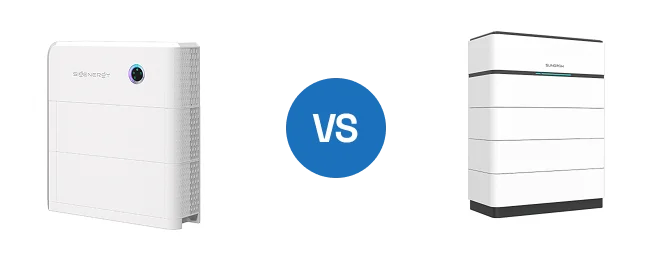
SIG Energy vs Sungrow
Sungrow vs GoodWe