

Portable EV Chargers: How They Work, Charging Speed & Are They Worth It?
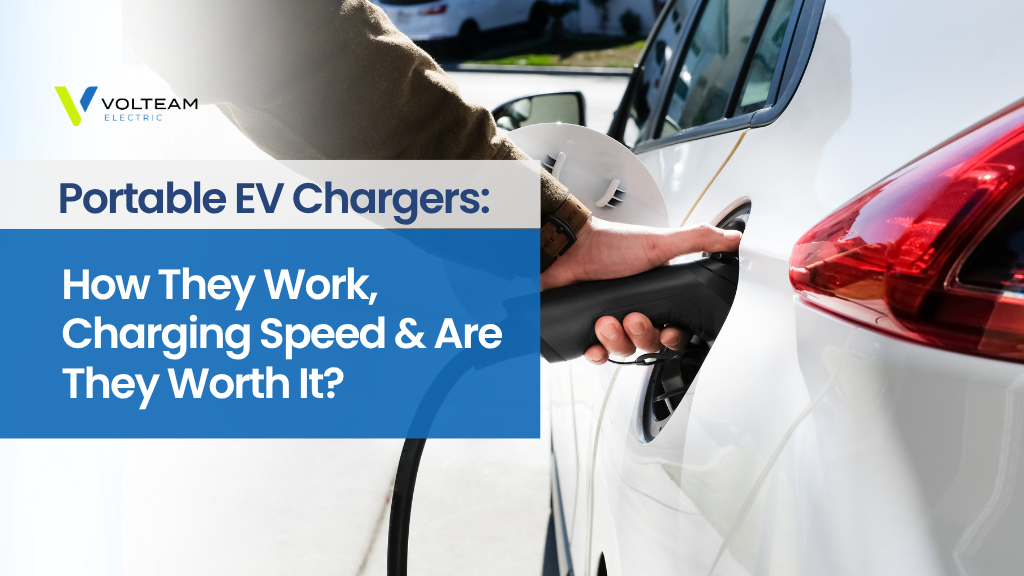
A portable EV charger is a charging cable with a small control box built into it. It lives in the boot next to the spare tyre, or on a hook in the garage until you need it.
One end plugs into your car’s charging port. The other end plugs into a power point, so there’s nothing to bolt to a wall and no installation to book.
This guide settles four things: how fast it really charges, what to check before you buy, how it compares with a fixed charger at home, and how to use it safely. You’ll also see who portable chargers suit and who tends to outgrow them.
Is a Portable EV Charger Worth It?
Yes, a portable EV charger is worth it if you want an affordable way to top up from a power point and you’re happy with slower charging.
A portable EV charger suits:
- Renters who can’t fit a wall unit
- Drivers who travel and want a charger in the boot
- Households with a second car that only does short trips
- Anyone who needs a backup charger at home
- Drivers with a short daily commute
What Is Inside a Portable EV Charger and How It Works
The cable has three parts. At the car end there’s a Type 2 plug, which is the connector used on nearly every new electric car sold in Australia. At the other end there’s a standard plug for the power point.
In the middle sits the control box. It checks the connection with your car and tells it how much current it can safely draw. The power only switches on once the car says it’s ready.
The part that actually charges the battery is the onboard charger inside your car. It turns the power point’s alternating current into the direct current a battery stores. The cable and box are the safe link between the two.
Most portable chargers are compact. A 10 amp unit weighs around 2kg and coils into a small bag, so it fits beside the spare tyre.
Charging Speed by Socket Type
Charging speed depends on the outlet type and the amp rating of the cable, because together they set how much current flows. Power is measured in kW (kilowatts), which is how fast energy flows. A battery’s size is measured in kWh (kilowatt-hours), the amount of energy it can store.
| Where you plug in | Typical power | Range added per hour (estimate) | A 10-hour overnight stop adds (estimate) |
| Standard household power point (10 amp) | 1.8 to 2.4kW | 10 to 15 km | 100 to 150 km |
| 15 amp power point (wider earth pin) | Up to 3.5kW | 15 to 20 km | 150 to 200 km |
| 32 amp single phase socket fitted by an electrician | Up to 7kW | 35 to 45 km | 350 to 450 km |
Single phase means your home gets its power through one live wire, which is how many Brisbane houses are supplied. Most household power points are 10 amp, so a 10 amp cable delivers up to about 2.4kW there. The last row applies only to a socket installed for the purpose, and only if your car can accept 7kW.
Many sellers suggest running at 8 amps on a standard power point, which is about 1.8kW. That’s why 10 to 15 km an hour is the sensible figure to plan around.
That overnight figure is plenty for a short daily commute. For full charging times by battery size, our guide on how long an electric vehicle takes to charge does the maths.
Can a portable EV charger reach 22kW?
A 32 amp unit gives about 7kW on a single phase supply. Only on a three phase supply (three live wires instead of one) can it reach up to about 22kW, and only if your car’s onboard charger accepts that much, because the car sets the limit. Those figures apply to dedicated sockets, since most household power points are 10 amp.
At about 7kW, a 32 amp unit can take a 60kWh battery from 20% to 80% in roughly 5 to 6 hours. That’s an estimate that allows for charging losses.
What to Check Before You Buy Portable Chargers
Compare portable chargers on these points rather than on a brand name, since a portable charger can use any compatible power point once the plug and amp rating match:
- Car-end plug: Type 2 suits almost every current model. Check your car’s charging port first, because a few older imports use a different type.
- Power point plug: A 10 amp plug fits a standard Australian power point. A 15 amp plug has a wider earth pin and needs a matching 15 amp socket.
- Adjustable amp settings: A unit equipped with adjustable settings lets you lower the current for older wiring or a shared circuit.
- Cable length: Five metres is common, and some run to 10. Measure from the power point to your car’s port, then add a little slack.
- Protection: Look for built-in residual current protection, a safety switch in the control box that cuts the power if electricity leaks. Also look for the RCM (Regulatory Compliance Mark) on the unit itself, not just the online listing.
- Weather rating: An IP (ingress protection) rating is two digits on the control box. The first covers dust and the second covers water, so a higher second digit copes better with rain.
- Warranty: An Australian warranty and local support make a replacement far easier.
Some models add screens and scheduling. Our smart charger guide covers those features separately.
Portable or Fixed EV Charger at Home: Where Each One Wins
A fixed charger is a wall-mounted unit wired to its own circuit by a licensed electrician. Here’s how the two compare for a household in South East Queensland.
| Portable EV charger | Fixed home charger | |
| Typical power on a single phase home | 2.4kW on a standard power point | Commonly 7kW |
| Overnight range added | 100 to 150 km | Often 300 km or more |
| Setup | Plug in and go | Installed by a licensed electrician |
| Upfront cost (market estimate) | About $170 to $700 for the unit | About $1,200 to $3,000 installed |
| Travels with you | Yes | No |
| Who it suits | Renters, travellers, second cars, backup | Daily drivers and busy households |
Portable chargers win on price and flexibility. A fixed unit wins on speed and day-to-day convenience, since the cable is always ready on the wall.
Many drivers start with portable chargers and move to a fixed one once charging becomes part of the weekly routine. Our guide on the benefits of a home EV charger covers that step in more detail.
Using a Portable EV Charger Safely at Home and on the Road
Which power point can portable chargers use?
Portable chargers can plug into any compatible power point, meaning the plug fits and the amp rating suits the cable. Choose one an electrician has checked, with sound wiring behind it and a safety switch on the circuit.
Plug the charger straight into the wall. Extension leads aren’t built to carry a steady load for hours, and manufacturers’ instructions typically say to avoid them. If your car is parked too far away, a unit with a longer cable length is the better fix.
Outdoor use and weather
A unit with a good IP rating copes with rain on the control box, so charging in a carport or driveway is fine. Keeping the plug connection under cover adds an extra margin.
Everyday habits and road use
A few easy habits keep things smooth:
- Uncoil the cable fully so heat can escape
- Match the amp setting to the power point
- Check the cable for kinks or wear before each use
- Feel the plug after the first hour of a new setup, where it should be no more than warm
- Store the cable dry and loosely coiled between uses
On the road, ask the owner before you plug in at a relative’s house or a caravan park. Most power points you’ll find are 10 amp, so expect the slower end of the table.
Where Volteam Fits When You Outgrow a Portable Charger
Volteam installs fixed, wall-mounted EV chargers, and that’s a common next step for daily drivers after a portable unit. We’ve completed more than 10,000 installations across South East Queensland, so we know how Brisbane households really live with their cars.
Share your car model and your usual weekly distance. We’ll give you an honest view on if a portable charger already covers it, or if a fixed one is worth fitting.
Volteam is a Brisbane team that installs solar, batteries and EV chargers. If you’d like to talk it through, get in touch.
Frequently Asked Questions About Portable EV Chargers
Do electric cars come with a portable charger?
Many do, though it varies by brand and model, so check the box and the car’s listing. The cable supplied is often limited to 10 amps to suit a standard power point, which fits the slower end of the speed table.
How much does a portable EV charger cost?
Most Type 2 portable units in Australia sit between about $170 and $700. A basic 10 amp model usually costs $280 to $500, while 32 amp units run higher, often $700 to $900. These are market estimates, and prices move often.
Which portable EV charger is best for my car?
The best one matches your car’s charging port and the power point you’ll use most. It also pays to read your car’s maximum rate for alternating current charging in the manual, because a unit that delivers more than your car accepts won’t charge it any faster.
Do I need an electrician to set up a portable charger?
Not for a standard 10 amp power point, since the cable simply plugs in. A 15 amp or 32 amp socket does need a licensed electrician to fit it. It’s also worth having an electrician check any power point you’ll use regularly.
Can I take a portable EV charger on a road trip?
Yes, and it’s handy as a backup for stays where you can plug in overnight. Plan on 8 to 10 hours for a meaningful top-up. For a quick stop on the highway, a public fast charger is the better tool.