

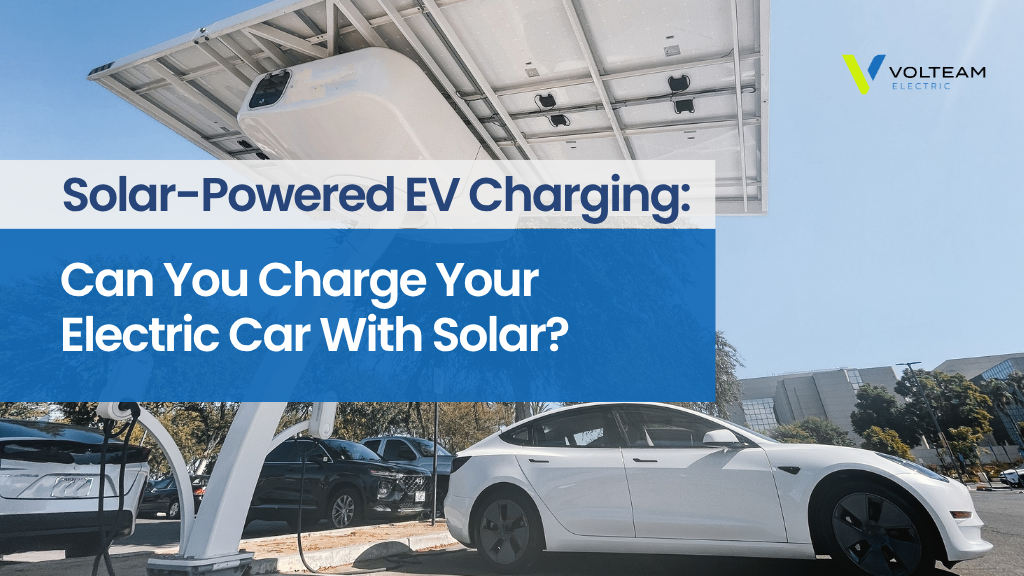
Solar-Powered EV Charging: Can You Charge Your Electric Car With Solar?
Rooftop panels make most of their power around midday, while most cars sit parked at home overnight. That mismatch is the whole question when you want to run a car on the sun.
A solar powered EV charger, a change in the hours you charge, or a home battery can each close the gap. This guide shows you all three ways and how much extra solar a car adds.
Yes, a Solar Powered EV Charger Can Run Your Car From Your Roof
Yes, you can charge an electric car with solar panels, and the three ways to do it are:
- A solar-aware charger sends your spare solar power to the car while the sun is up.
- Charging at the hours you are home, such as weekends, uses midday power directly.
- A home battery stores midday power and releases it when you plug in at night.
- You can combine any of the three.
Why Timing Decides How Much Solar EV Charging You Get
A rooftop solar system makes most of its power from mid-morning to mid-afternoon. Your household energy usage tends to peak earlier and later in the day, when the sun is low or gone.
If your car starts charging at 7 pm, it draws from the grid. If it charges at noon, it draws from your roof first. How much solar EV charging you get depends mostly on when the car is plugged in and ready.
Three Ways to Charge Electric Vehicles With Rooftop Solar
Each way fits a different daily routine. This table shows how they compare.
| Way | How it works | Who it suits | What you need |
| Solar-aware charger | Reads your spare power and turns the charging speed up or down to match | Homes where the car is plugged in during daylight | A charger with a solar mode, a CT clamp, a licensed installer |
| Charging when you are home | You plug in while the sun is up | People who work from home, households with someone around by day, weekend drivers | Any home EV charger, plus a timer to start charging in the morning |
| Home battery | Midday power is stored, then charges the car after dark | Homes where the car is out all day | A battery compatible with your inverter |
A solar-aware charger that uses spare power
A standard charger delivers one fixed speed. A solar-aware charger changes its speed minute by minute, so it follows what your roof is making beyond your home’s electricity usage. When a cloud passes, it eases back, and when the sun returns, it speeds up again.
Home charging while the sun is up
Weekends, work-from-home days, school holidays and days off all put the car in the driveway while the sun is up. Home charging on those days can start in late morning with a simple timer on a home EV charger, when your solar output is strong.
Battery storage for evening charging
A battery storage system holds midday output from your panels and releases it after dark. As a rough guide, a 10 kWh battery (kWh means kilowatt-hours, the unit on your power bill) holds about 55 km of driving for a car that uses 18 kWh per 100 km. Your house uses some of that too, so size panels and battery together.
What a Solar Powered EV Charger Does Differently
The key part is a CT clamp, short for current transformer clamp. It is a small sensor that clips around the main cable at your switchboard and reads how much power is flowing into or out of your home.
When your panels make more than the house uses, the excess electricity flows out toward the grid, and the clamp sees it. The charger then raises its speed in small steps until your solar surplus is going into the car instead.
Solar mode and the 1.4 kW starting point
The charging standard for electric cars sets a lowest charging current of 6 amps. On a 230 volt supply that is about 1.4 kW, so solar-only charging begins once your spare power reaches roughly that level. Makers publish slightly different starting points, but they all sit close to that figure.
Most solar chargers offer several charging modes. A solar-only mode waits for spare power, and a mixed mode adds grid power to keep the car charging, which gives efficient charging on patchy days. Many chargers also have a fast mode that ignores the sun.
Smart features that help solar charging
The solar mode is the most useful of the smart features on a smart EV charger, because it turns spare power into driving range without daily effort. Smart charging of this kind only works when the charger can see how much solar your home is making.
Smart charger apps help here. After app setup, which your installer usually handles, the app can show how much of each charge came from the roof and how much from the grid. A charger with dynamic load management also eases its speed when the rest of the home draws heavy power, so the car never overloads your supply.
How Much Extra Solar Does an Electric Car Need?
One worked line shows the size of it. The average passenger vehicle in Australia travels about 11,100 km a year. Using 18 kWh for every 100 km (swap in your own model’s figure), the car needs about 2,000 kWh a year.
Brisbane’s solar rating from the Clean Energy Regulator is 1,382 kWh per kW of panels each year. Dividing 2,000 by 1,382 gives roughly 1.5 kW of extra panels, before charging losses. This is an estimate, and the full wattage maths sits in our guide to how many solar watts a home needs.
What Your Home Needs for a Dedicated EV Charger
A dedicated EV charger runs on its own circuit. A dedicated circuit is a wiring run with its own protection at the switchboard that feeds the charger and nothing else. Makers require a licensed electrician for this electrical work.
What the charger installation and charging setup involve
The electrician who will install the charger first checks your home’s electrical system, mainly the switchboard’s main switch rating and spare space. Next comes your supply. Many Australian houses are supplied through a single live wire, known as single phase power. Three phase power has three live wires, so more power can flow at once.
On single phase, a fixed charger can run at up to about 7.4 kW, and a three phase supply can allow charging up to about 22 kW if the car accepts it. Your car’s own onboard charger sets the real limit, so check what your model accepts.
Some homes, often older ones, need switchboard work first, and the electrician will tell you before anything starts.
What solar compatibility adds to EV charger installation cost
A solar-ready charger requires a CT clamp and the cable that connects it to the charger. The electrician will install the clamp at your switchboard so it can see the whole home’s power, which completes the solar charging setup.
Installed costs vary with the site, so your total cost depends on the switchboard and where the charger will sit, and our EV charging costs guide has the dollar ranges.
Choosing the Best EV Charger for Solar
The best EV charger for your home is the one that suits your solar system and your driving week. Use this checklist when you compare:
- Solar mode: a solar-only mode and a mixed mode.
- Surplus detection: a CT clamp at the switchboard, or a link to your inverter or meter.
- Starting point: the lowest spare power the charger needs to begin.
- Phase support: single phase or three phase, to match your supply.
- Warranty: the length of cover, and who services it locally.
- App: clear data on how much of each charge came from your roof.
The Fronius Wattpilot and the myenergi Zappi both advertise charging from solar surplus, so they are examples of chargers with this feature. Head-to-head comparisons of brands sit in a separate post.
Matching the right EV charger to the hours you are home
Electric car drivers who are home by day get the most from a solar-only mode. Those who plug in after work do better with a mixed mode or a battery. Picking the right EV charger starts with that routine, and the right charger is the one that fits it, more than any single spec.
Checking the charger fits your solar system and switchboard
Your inverter converts the direct current from your panels into the alternating current your home runs on. Solar integration depends on how the charger reads your solar output through that inverter and your meter, so ask the installer to explain it.
If you have a battery system, it may use some spare power before the clamp sees it, so confirm how the setup shares power. A charger that fits both your solar system and switchboard gives you reliable charging day after day.
Environmental Benefits and Lower Bills From Charging With Solar Energy
Carbon footprint of solar versus grid charging
Rooftop solar makes electricity without burning anything. The Queensland grid, on the 2026 national greenhouse accounts factor, averages about 0.65 kg of greenhouse gas emissions (carbon dioxide equivalent) for every kWh.
Run the 2,000 kWh a year from our worked line entirely on your own panels and you avoid about 1.3 tonnes of those emissions, compared with charging that same energy from the grid. The grid keeps adding renewable energy, so the gap narrows a little each year, and the saving is real now.
Energy efficiency and lower electricity bills
Solar energy made on your roof and used in your driveway doesn’t travel far, and you don’t pay a retailer for it. Every unit your car takes from the panels means one less to buy from your retailer later, which helps reduce costs on both electricity bills and energy bills.
Over a year this can significantly reduce what you buy from the grid, which makes your roof a cost effective fuel supply. Another guide covers how export payments compare with using your own power.
It also brings greater energy independence. More of your household’s energy comes from your own roof, and less depends on changes in electricity rates.
How Volteam Electric Sets Up Solar-Ready EV Charging
Volteam Electric is a Clean Energy Council (CEC) accredited installer, so the solar side of this job is in accredited hands. Solar and charging work best when one team understands the panels and the charger together.
We work across Brisbane and South East Queensland. Tell us when your car is home and what your roof makes, and we’ll recommend a setup to match.
Frequently Asked Questions
Can I charge my EV directly from solar panels?
In practice the power goes from the panels through your inverter and into your home’s wiring, and the charger draws from there. A solar-aware charger then picks up whatever is spare. During the day your car is effectively running on rooftop power.
Can an EV charging station be powered by solar?
Yes. A motor trade association opened a 60 kW public charger at its Burwood head office in Sydney in 2023, and it describes the site as powered by rooftop solar. This kind of EV charging infrastructure is still uncommon in Australia, and most solar charging happens at home.
What happens to solar charging when clouds pass over?
Spare power can drop below the roughly 1.4 kW starting point for a short time. In a solar-only mode the charger pauses and resumes when the sun is back. In a mixed mode it tops up from the grid, so the car keeps charging at a steady rate.
How much driving does a day of rooftop solar cover?
A 5 kW system in Brisbane averages about 19 kWh a day across the year, going by the 1,382 kWh per kW rating.
For a car that uses 18 kWh per 100 km, that is enough electricity for about 100 km of driving. The average Australian passenger vehicle covers about 30 km a day, so a 5 kW system can cover a typical day of driving, though your house uses part of that output.