

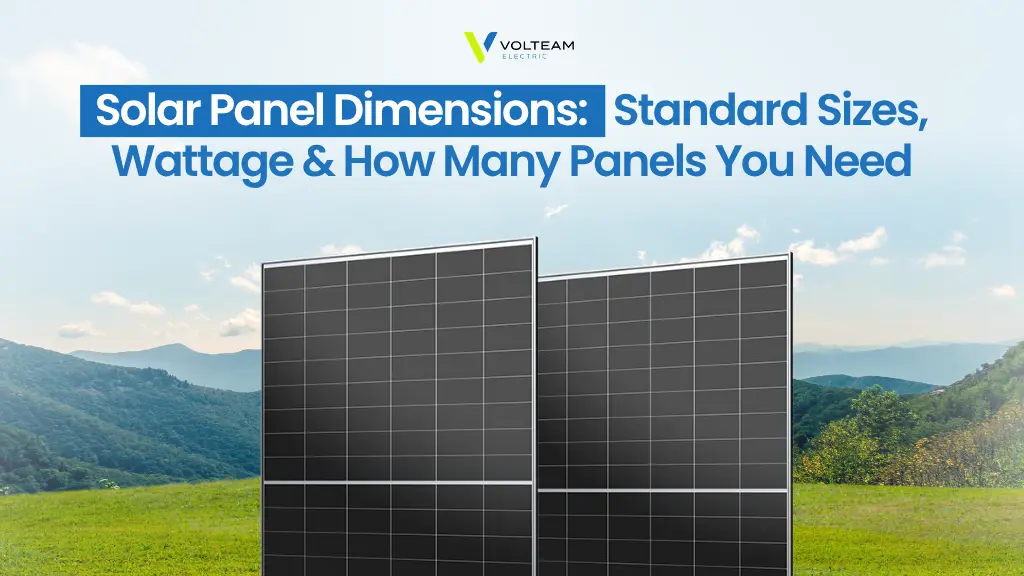
Solar Panel Dimensions: Standard Sizes, Wattage & How Many Panels You Need
Lay one current residential panel flat on the ground and it covers an area just under a king single mattress. Most measure about 1,720 to 1,760 mm long and 1,120 to 1,135 mm wide, and they weigh close to 21 kg.
The commonly quoted rule of thumb is a panel about 1.7 m tall by 1.0 to 1.1 m wide and 30 to 40 mm thick. Current datasheets show slightly longer panels, because modern panels pack far more watts into the same frame. The sections below use datasheet numbers to show what fits on a Brisbane roof.
What Are the Standard Solar Panel Dimensions on a Brisbane Roof?
A current residential panel measures about 1,720 to 1,760 mm long by 1,120 to 1,135 mm wide, and weighs about 21 kg.
- Length: 1,722 to 1,762 mm
- Width: 1,118 to 1,134 mm
- Frame depth: 30 mm
- Weight: 20.8 to 21.5 kg
- Rated power: about 400 to 485 W per panel
- Area per panel: about 1.9 to 2.0 m²
Datasheet Dimensions for Five Current Residential Solar Panels
Rated power is the output a panel is certified to produce in standard test conditions: 1,000 W/m² of sunlight with the cells at 25°C. The figures below come from each manufacturer’s own datasheet, and dimensions are length x width x depth.
| Model | Rated power | Dimensions (mm) | Weight (kg) | Cells and type |
| Trina Vertex S+ (TSM-NEG9R.28) | 450 to 475 W | 1,762 x 1,134 x 30 | 21.0 | 144 cells, N-type TOPCon |
| Aiko Neostar 3S54 (AIKO-A-MCE54Mb) | 460 to 485 W | 1,762 x 1,134 x 30 | 21 (plus or minus 3%) | 108 cells in a 6 x 18 layout, N-type ABC |
| Jinko Tiger Neo (JKM435-460N-54HL4R-V) | 435 to 460 W | 1,762 x 1,134 x 30 | 21.0 | 108 half-cut cells (54 x 2), N-type |
| LONGi Hi-MO 6 Scientist (LR5-54HTH) | 445 to 455 W | 1,722 x 1,134 x 30 | 20.8 | 108 cells in a 6 x 18 layout |
| REC Alpha Pure-R | 400 to 430 W | 1,730 x 1,118 x 30 | 21.5 | 80 half-cut heterojunction cells |
All five panels are within 40 mm of each other in length, so the frame hardly changes what fits on your roof. What changes is the wattage inside the frame, which runs from 400 W to 485 W. Panels were commonly quoted at 350 W to 500 W over recent years, and current home panels sit at the top of that range.
Trina Solar panels in the Vertex S+ range list up to 475 W on the 2026 datasheet, in the same 1,762 x 1,134 x 30 mm frame as the earlier 460 W edition. Trina Vertex panels are one example of a frame size staying put while power climbs.
Trina’s 2024 Australian edition lists 22.0% to 22.5% efficiency for its 440 to 450 W bins and describes the range as built on Trina’s 210 platform.
Why Solar Panels Got Bigger and More Powerful
Older 60-cell panels were roughly 1.65 m by 1 m and typically rated around 330 W. A current panel is a little larger, rated 100 W or more higher, and built from bigger cells.
Two changes explain most of the gain:
- Half-cut cells. A 60-cell panel and a 120 half-cut cell panel are the same size, because each full cell is cut in two. The same goes for 72 and 144. Each half carries less current, which reduces resistance losses inside the panel.
- Larger wafers. Cells are now cut from silicon wafers of around 182 mm and 210 mm, which is bigger than the 156 mm cells of older panels. Bigger cells mean more power from each one.
Residential Solar Systems Versus Commercial Panel Formats
Residential solar systems use panels around 1.7 to 1.8 m long. Commercial formats are longer, often 2.2 m or more, and carry 144 cells instead of 108.
Modern panels run from about 410 W for compact home formats to around 600 W for the largest commercial ones. Older 72-cell commercial panels were nearer 2.1 m by 1.04 m.
A Jinko Tiger Neo 72-cell panel rated 570 to 590 W measures 2,278 x 1,134 mm, is 30 to 35 mm deep depending on the frame, and weighs about 27 kg. That is a 550 W class panel and above. It suits flat commercial roofs and ground mounts, where installers have more room and lifting gear.
On a pitched home roof the extra length is harder to carry, harder to fit around hips and vents, and leaves awkward gaps at the roof edge. Thin-film panels have no rigid frame, so their sizes vary, and portable panels are built for low weight. Neither is a typical choice for a home roof.
Wattage, Efficiency and Panel Size
Efficiency is the share of sunlight a panel converts into electricity. All five panels above are monocrystalline, meaning each cell is cut from a single silicon crystal, which gives higher efficiency than older polycrystalline cells. The Trina datasheet lists 22.5% at 450 W up to 23.8% at 475 W in the same frame, while the REC datasheet lists 22.3% at 430 W.
That difference matters on a limited roof. By area, the 475 W Trina panel delivers about 238 W for every square metre, against about 222 W for the 430 W REC panel.
Heat performance is the second size-related spec. The temperature coefficient shows how much power a panel loses for each degree its cells run above 25°C. REC and Trina list 0.24% per °C, Aiko lists 0.26%, and Jinko and LONGi list 0.29%.
On a hot Brisbane afternoon, cells can run about 40°C above the test temperature (an illustrative figure). That is a loss of roughly 9.6% at 0.24% per °C and 11.6% at 0.29%.
Each datasheet also lists a warranty. Trina’s, for example, offers 25 years on the product and 30 years on power output. Brand-against-brand ranking is covered on our solar panel comparison page, and lifespan is covered in our guide to how long panels last.
How Many Panels Does Your Solar System Need?
Start from the solar system size you have chosen in kW, then divide by the panel wattage. Choosing that size from your bills is covered in our guide to how many solar watts you need.
- Panel count = system size in watts divided by panel wattage, rounded up
- Panel area = panel count x 1.998 m² (a 1,762 x 1,134 mm panel)
- Roof area = panel area plus 20 to 30% for gaps, edge clearances and access paths
The table uses a 450 W panel, which sits in the middle of the datasheet range. 6.6 kW, 10 kW and 13 kW are the most common home system sizes, and at 13 kW each panel is about 1.76 m by 1.13 m. Roof areas are estimates.
| System size | Panels at 450 W | Array rated power | Panel area | Realistic roof area |
| 6.6 kW | 15 | 6.75 kW | about 30 m² | about 36 to 39 m² |
| 10 kW | 23 | 10.35 kW | about 46 m² | about 55 to 60 m² |
| 13 kW | 29 | 13.05 kW | about 58 m² | about 70 to 75 m² |
An array is the full set of panels on your roof. Panel capacity adds up quickly, so a larger system needs roof planes that can hold a wider block of panels without shading.
Matching panel count to your energy consumption
Your energy consumption sets the system size, and the system size sets the panel count. Higher panel wattage means fewer panels for the same kW.
A 6.6 kW system needs 14 panels at 475 W, 15 at 450 W, or 16 at 430 W. The 16 panel version needs about 3 m² more roof than the 14 panel version.
Fitting Panels Into Your Roof Space
Orientation, shading, roof shape and edge clearances decide how many panels actually fit in your roof space, often more than the total area does.
- Orientation: north-facing planes produce the most, while east and west planes still work well in Brisbane.
- Shading: trees and neighbouring buildings cut output, so the panel layout avoids them.
- Roof shape: hips, valleys, vents and skylights break up an otherwise usable plane.
- Edge clearances: panels sit back from the roof edge and ridge, which takes more area than most people expect.
Portrait suits tall, narrow roof planes and landscape suits wide, shallow ones. Designers often mix both on one roof.
With limited roof space, higher-wattage panels do the work. For 6.6 kW, 14 Trina panels at 475 W cover about 28 m², while 16 REC panels at 430 W cover about 31 m².
Weight matters too. A 21 kg panel over 2 m² puts about 10.5 kg per m² on the roof before racking, which is a figure worked out from the datasheet. A designer checks the roof structure and mounting hardware for tile, Colorbond and flat roofs separately.
Future Proofing Your Roof for Solar Batteries and an Electric Vehicle
Future proofing starts when the layout is drawn, so leave room for your future energy use. A roof that holds a few extra panels later is cheaper to extend than one filled edge to edge today.
Common later additions include solar batteries, an electric vehicle charger, air conditioning, or a pool pump. Each one lifts your energy needs, and more electricity generated at home covers more of them. Battery sizing is covered in our guide to what size solar battery your house needs.
Solar batteries and energy independence
A battery stores surplus daytime power for the evening, which moves your home closer to energy independence. Panels themselves do not store anything.
If a battery is likely within a few years, ask your installer to confirm that the inverter pairing and switchboard suit it. Your future needs are cheaper to plan in than to retrofit.
How each extra panel lowers your carbon footprint
Brisbane sits in the Clean Energy Regulator’s Zone 3, rated at 1.382 MWh per kW of panels per year. By that figure, one 450 W panel represents about 620 kWh of electricity a year.
Every kilowatt hour generated on your roof is one you don’t draw from the grid, so each extra panel reduces your household’s carbon footprint. It also adds to your cost savings on electricity bills and your potential savings over the life of the system.
What a Good Quality Solar Power Quote Shows
A good quality solar power quote tells you the panel size in writing. Look for an itemised quote that lists:
- The exact panel model, with its datasheet dimensions and rated power
- The number of panels and the total solar system size
- Inverter pairing, meaning the inverter model and how the panels connect to it within its voltage range
- Switchboard upgrades, if your board needs one
- Written confirmation of the panel layout and where each row sits on the roof
- The panel and power warranty terms
Installation costs and your final price depend on these details, so a vague quote leaves room for surprises. Putting two quotes side by side is the easiest direct comparison, because identical kW figures can hide different panels.
The federal STC rebate is a discount taken off the upfront price, and it depends on system size rather than panel count. In 2026 the STC discount uses the Zone 3 rating and a deeming period of 5 years, so a 6.6 kW system creates about 45 certificates (6.6 x 1.382 x 5, rounded down). Ask your installer to show the number on the quote.
How Volteam Checks Your Roof Before a Layout Is Final
Panel dimensions only matter once they meet a real roof. Volteam holds QLD Electrical License #72286, and we check the roof and the electrical side before any layout is final.
You get a panel layout drawn from the datasheet size of the panel on your quote, plus a look at your switchboard. If you’d like to talk through what fits on your roof, our Brisbane team will take you through the options.
Frequently Asked Questions
What are the dimensions of a 550 W solar panel?
Panels in the 550 W class and above are typically around 2.2 to 2.3 m long, which is longer than a home panel. One example is the Jinko Tiger Neo 570 to 590 W panel at 2,278 x 1,134 mm and about 27 kg. They are usually used on commercial roofs, not homes.
Should solar panels go in portrait or landscape?
It depends on the roof plane. Portrait fits tall, narrow planes and landscape fits wide, shallow ones, and your designer can mix them on one roof. The panel dimensions are the same either way, so the choice is about fitting more panels around vents and edges.
Will solar panels fit on a small or tiled roof?
Usually yes, because a 6.6 kW system needs only about 36 to 39 m² of realistic roof area at 450 W. On a small roof, higher-wattage panels reduce how many you need. Tiled roofs use different mounting hooks, and the designer allows for that.
Is a bigger solar panel always better?
No. A larger frame only helps if you have the roof area to hold it. Watts per square metre and the shape of your roof matter more than frame size, and the datasheet shows how much power each model delivers for its area.