

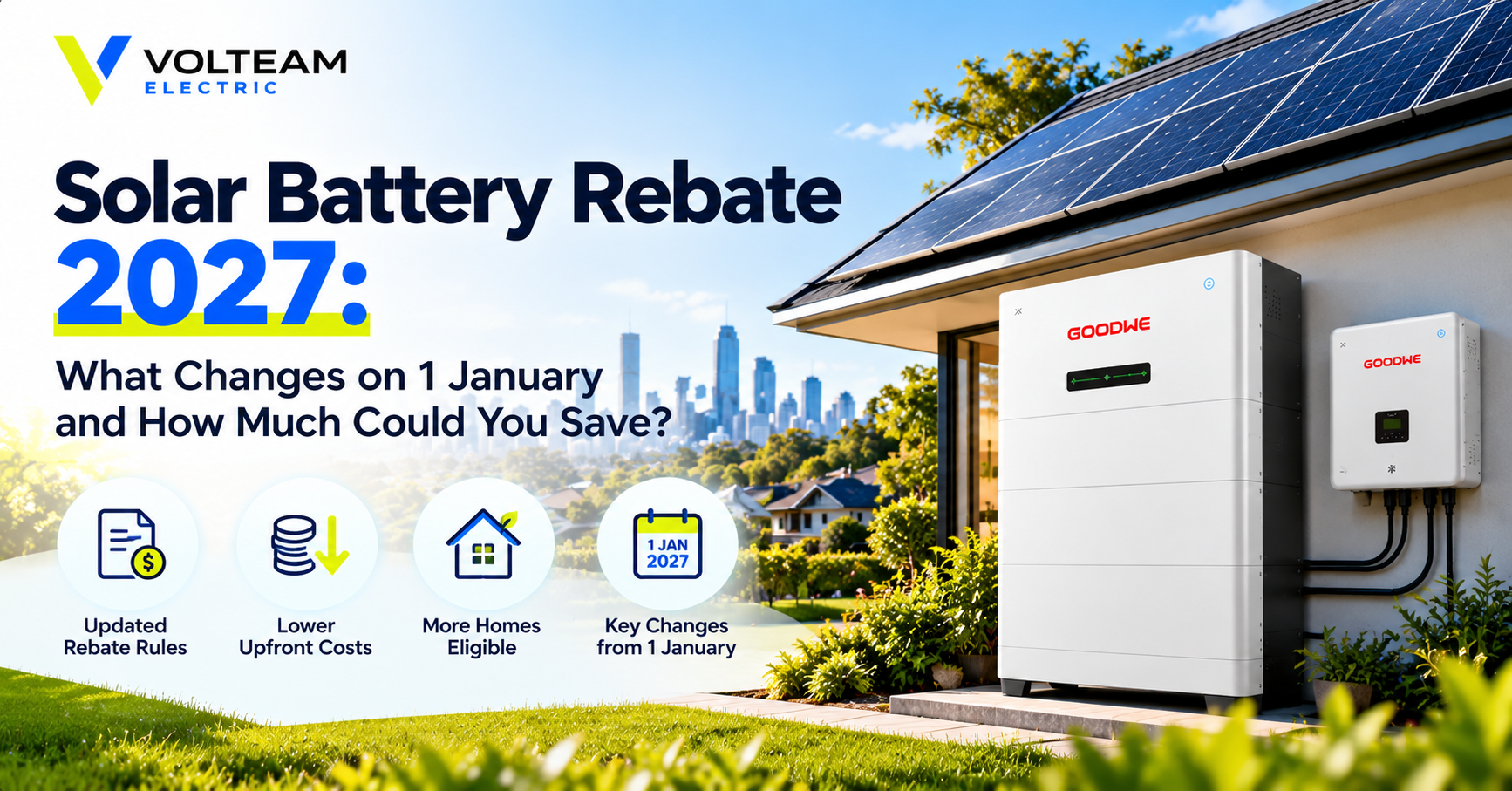
Solar Battery Rebate 2027: What Changes on 1 January and How Much Could You Save?
Understanding the Solar Battery Rebate Changes 2027
If you’re considering installing a solar battery in Australia, the upcoming solar battery rebate changes on 1 January 2027 are worth evaluating before getting started.
Solar battery rebates in the form of the Cheaper Home Batteries program are created to make eligible home energy storage systems more accessible, budget-wise. But with the scheduled reduction of rebates in the beginning of 2027, qualified homeowners are looking at smaller upfront discounts on installations.
On the brighter side, it’s good to know that the battery rebate is not ending on 31 December 2026. Instead of ending this year, the government is gradually reducing the support available through the program until 2030 instead.
The question is, how much could the upcoming rebate changes in 2027 affect your upfront installation costs? Would it make sense to install a solar battery before 2026 ends, or would it be more worthwhile to wait until the new solar rebates take effect in 2027?
We explain the recent changes on solar battery rebates, how they work and what these updates could mean for your planned home energy storage installation.
Solar Battery Rebates in 2027: A Comprehensive Guide
To recap, there are two separate federal incentives that apply to Queensland homes:
- The solar rebate (STCs, under the Small-scale Renewable Energy Scheme)
- The battery rebate (Cheaper Home Batteries Program)
If you’re on the lookout for an energy storage system, it’s worth noting that the battery rebate won’t be as high. This is because under the Australian Government’s Cheaper Home Batteries Program, the discount calculation is scheduled to reduce again from 1 January 2027. Understanding what this change means can help you plan your next steps.
Solar Battery Rebates: What is Changing in 2027?
Getting homeowners substantial assistance through rebates when installing a solar battery speaks volumes about Queensland’s dedication to sustainability. This assistance comes in the form of the Cheaper Home Batteries Program, which provides an upfront discount on eligible battery installations through the Small-scale Technology Certificates (STCs) mechanism.
Just last 1 May 2026, the program moved to a revised calculation method, with the discount factor scheduled to decrease every six months.
The published schedule sets the STC factor at 6.8 for installations from May to December 2026 (current factor). From 1 January 2027, it falls to 5.7 for the first six months of the year.
This means eligible battery installations completed from January 2027 will generally receive a smaller certificate-based discount than comparable installations completed in late 2026, assuming other relevant factors remain unchanged.
In the next two installation periods covering 2027, the new STC factors are as follows:
| Period | STC Factor |
| January-June 2027 | 5.7 |
| July-December 2027 | 5.2 |
The reduction continues until the end of 2030, when the scheme closes. It’s important to note that the program’s STC factors are not dollar amounts or fixed discount percentages. The actual discount eligible installations could get still depends on battery capacity, the applicable calculation rules, and the value of the certificates. Simply put, the change is a reduction in the discount calculation, not the end of the entire scheme.
How Much Could the Battery Rebate Decrease in January 2027?
The dollar impact depends on the battery’s usable storage capacity, the applicable STC factor and the value of each certificate. For a simple illustration, consider the difference between the current factor of 6.8 and the January 2027 factor of 5.7. That’s a reduction of approximately 16.2% in the factor itself.
However, it doesn’t mean that your total battery discount will fall by exactly 16.2%. The program applies different calculation rates to different portions of larger batteries. Then there’s the market value of certificates that also affects the final dollar discount.
To make it easier to digest, let’s apply the announced January-June STC factor using the certificate value of $40. Assuming the battery has 10 kWh of usable capacity and each STC is worth approximately $40, calculation would look like this:
| Calculation | Installed by 31 December 2026 | Installed from January 2027 |
| STC Factor | 6.8 | 5.7 |
| Estimated rebate | $2,720 | $2,280 |
| Estimated reduction in discount: $440, or approximately 16.2%. | ||
Remember, the above are estimates and not fixed rebate totals.
What does this mean for you?
If you’re already planning to install a battery, getting a quote from your preferred local installer before the end of 2026 under the current rate may be worthwhile. That is if you’re already set on having a solar battery installed. The right system should still match your electricity consumption, solar generation and budget, so it’s important not to choose a battery solely to secure a larger rebate.
How Does the Cheaper Home Batteries Program Work?
The Cheaper Home Batteries Program helps eligible Australian households, businesses and community organisations reduce the upfront cost of installing eligible small-scale battery systems.
The program works through Small-scale Technology Certificates, commonly called STCs. These certificates have a financial value and are used to calculate the discount available for an eligible battery installation.
In many cases, the installer or retailer applies the discount to the upfront price, provided the customer meets the program’s requirements and agrees to the relevant certificate arrangements.
The Australian Government describes the program as providing a discount of around 30% on eligible battery systems, although the actual amount depends on the installation and applicable rules.
How is the Battery Discount Calculated?
The discount is influenced by three main factors:
- Usable battery capacity: The amount of energy the battery can deliver for use in your home or business.
- Applicable STC factor: The factor determined by the relevant installation period.
- STC value: The price received for the certificates, which affects the dollar value of the discount.
Since 1 May 2026, the program has also applied different calculation rates according to battery size.
| Usable battery capacity band | Applicable STC factor rate |
| Up to and including 14 kWh | 100% |
| Above 14 kWh up to and including 28 kWh | 60% |
| Above 28 kWh up to 50 kWh | 15% |
While eligible systems can have nominal capacities of 5–100 kWh, the certificate calculation is capped at the first 50 kWh of usable capacity, meaning installing a larger battery doesn’t automatically result in a larger rebate. For the official program rules, visit the Australian Government’s Cheaper Home Batteries Program and its guide to battery STCs.
Does the Battery Rebate End on 31 December 2026?
No. The federal battery rebate is not ending on 31 December 2026 under the published schedule. Instead, the STC factor decreases on 1 January 2027, followed by further scheduled reductions every six months. Eligible battery installations can continue to receive support under the program, subject to the rules and settings applicable at the time of installation.
This distinction matters because some headlines may make the January change sound like a final deadline for accessing government support. The more accurate interpretation is that the discount is scheduled to become smaller, rather than disappear altogether.
Does the Installation Date Matter More Than the Booking Date?
Yes, since the applicable STC factor is determined by the installation date, not the date you sign a contract or pay a deposit. For example, if you sign an installation agreement in December 2026 but the battery installation falls into January 2027, the lower January factor may apply. That’s why it’s important to confirm the installation schedule before making a decision based on the current rebate.
Additionally, it’s important to ask your installer whether the proposed installation is feasible and whether the quoted discount is based on the 2026 or 2027 STC factor. Will the quoted price change if the installation is delayed? Make sure you have all the information you need before signing an agreement to ensure you receive the rebates you expect.
Should You Install a Solar Battery Before January 2027?
It depends on your household’s energy needs, your budget, and how soon you intended to install a battery. The upcoming rebate reduction is surely one factor to consider, but it shouldn’t be the only reason to proceed.
Installing Before January 2027 May Make Sense If:
- You have already decided that a battery suits your energy needs.
- Your current solar system exports substantial excess electricity during the day.
- You regularly purchase electricity from the grid during the evening.
- Your property is suitable for battery installation.
- Your installer can confirm a realistic installation date.
- The quoted savings and expected bill reductions justify the investment.
Waiting May Make Sense If:
- You’re unsure whether a battery will deliver enough value for your household.
- You need time to compare battery models and installation quotes.
- Your current solar system needs upgrades before a battery can be installed.
- You’re considering a battery that’s larger than your household needs.
- The upfront cost doesn’t fit your current budget.
Battery prices, electricity tariffs, feed-in tariffs, usage patterns and installation costs can also change. These factors should be considered alongside the rebate.
To help you decide, start by understanding your energy consumption and comparing the total installed cost, estimated bill savings, and expected payback period. Then consider whether the earlier rebate makes installing before January worthwhile.
How Can a Solar Battery Help Reduce Electricity Bills?
A solar battery stores surplus electricity generated by your solar panels during the day so that you can use it later. Without a battery, excess solar electricity is sent back to the grid. While there’s a feed-in tariff for that excess electricity, the rate may be lower than the price you pay to import electricity from the grid.
With a solar battery, you can store some of that excess energy and use it during the evening or at other times when your solar panels aren’t generating enough electricity.
Potential benefits include:
- Greater use of your own solar energy: Store surplus daytime generation for later.
- Reduced grid electricity purchases: Use stored energy when your household needs it.
- More control over energy use: Depending on your system, you may be able to schedule battery charging and discharging.
- Potential backup power: Some batteries provide backup during a grid outage when configured with the required equipment and installation.
- Better alignment with household consumption: A correctly sized system can help match solar generation with the times you use electricity.
What Size Solar Battery Should You Choose?
Choosing the right battery size is important because both your potential savings and the rebate calculation depend on the system you install. A battery that’s too small may not cover much of your evening electricity consumption. A battery that’s too large may cost more than necessary and remain underused.
Here are considerations to ponder on when assessing battery capacity:
- Your average daily electricity consumption.
- How much solar electricity you export during the day.
- Your evening and overnight energy use.
- Whether you operate energy-intensive appliances.
- Your existing solar inverter and electrical setup.
- Whether you want backup power during outages.
- Your budget and expected payback period.
A household that exports substantial solar energy and uses more electricity in the evening may benefit from storage. A household with limited surplus generation may need a different solution.
Is the January 2027 Rebate Change Relevant to Brisbane Homeowners?
Yes, the Cheaper Home Batteries Program is a federal government initiative available to eligible consumers, so yes the January 2027 rebate change will affect Brisbane homeowners.
If you’re considering a battery installation in Brisbane or elsewhere in Queensland, Volteam can help you explore your options and understand the factors that affect the final cost.
How to Prepare for a Battery Installation Before January 2027
If you’re planning to install a battery in the coming months, taking a few practical steps can help you compare your options without rushing into a purchase. These steps will help you make a decision based on the full financial picture, rather than the rebate deadline alone.
1. Review Your Electricity Bills
Check your electricity consumption, imports from the grid and solar exports. This information can help establish whether a battery is likely to be useful.
2. Compare Suitable Battery Systems
Look at usable capacity, warranty, compatibility, monitoring features and installation requirements. Don’t select a system based on capacity alone.
3. Request an Itemised Quote
Ask for the total installed price, the rebate or STC discount, any additional electrical work and the assumptions behind the quote.
4. Confirm Eligibility
Check that the battery, installer and proposed installation meet the current Cheaper Home Batteries Program requirements.
5. Check the Installation Timeline
If you want the 2026 STC factor to apply, confirm whether installation can realistically be completed by 31 December 2026. A contract signed before the deadline does not, by itself, secure the earlier rate.
6. Compare Expected Savings
Ask for an estimate based on your electricity consumption, solar exports and tariff. Consider the expected payback period, as well as the upfront discount.
Frequently Asked Questions About the Solar Battery Rebate in 2027
What Happens to the Australian Battery Rebate on 1 January 2027?
The STC factor under the Cheaper Home Batteries Program is scheduled to decrease from 6.8 to 5.7 on 1 January 2027. This reduces the certificate entitlement for comparable eligible installations, although the actual dollar discount depends on battery capacity and certificate value.
Is the Federal Battery Rebate Ending in 2027?
No. The published schedule continues beyond January 2027, with further reductions every six months until the end of 2030. Eligibility and program settings should always be checked against the latest official guidance.
How Much Less Could I Receive If I Install My Battery in 2027?
For illustration, at $40 per STC, the difference between the announced 2026 and January 2027 factors could be approximately $440 for a 10 kWh battery, $594 for a 13.5 kWh battery and $669 for a 16 kWh battery. But these are just estimates, not guaranteed discounts.
Can I Secure the 2026 Battery Rebate by Signing a Contract in December?
Not simply by signing the contract. The applicable factor depends on the installation date. If the installation takes place in January 2027, the January factor may apply even if the agreement was signed in December.
Can I Claim the Battery Rebate If I Already Have Solar Panels?
Yes, an eligible battery can be connected to an existing solar PV system. The installation must meet the program’s requirements, including the relevant battery, installer and system eligibility criteria.
Do I Need to Apply Separately for the Cheaper Home Batteries Program?
In many cases, no separate application is needed because the installer or retailer arranges the certificate process and provides the discount. Alternative arrangements are possible, so confirm how the discount will be handled before signing your agreement.
Is a Bigger Battery Always Better Because the Rebate Is Available?
No. Since the program applies tapered calculation rates to larger batteries, each additional kilowatt-hour doesn’t receive the same level of support. As a general rule, the battery should be sized according to your energy use, solar generation, budget, and expected savings.
Will Battery Prices Fall When the Rebate Decreases?
Unfortunately, there is no guarantee that battery prices will fall enough to offset the reduction in the rebate. Compare actual installation quotes and calculate potential savings rather than assuming that either waiting or installing immediately will always be cheaper.
Can Brisbane Homeowners Access the Federal Battery Rebate?
Eligible Brisbane homeowners can access the federal program if their battery installation meets the applicable requirements. Confirm current eligibility, installation arrangements, and the discount available for your chosen system.
How Can I Find Out Whether Installing a Battery Is Worthwhile for My Home?
Review your electricity bills and solar export data, then request an assessment and itemised quote from an accredited installer like Volteam. Compare the total installed cost, available discount, expected bill savings, and estimated payback period before deciding.
Solar Battery 2027 Rebates: The Takeaway
The scheduled battery rebate reduction on 1 January 2027 is worth considering if you’re planning to install a solar battery in Australia. Eligible installations completed before the change may receive a higher certificate-based discount than comparable installations completed afterwards.
However, the rebate is only one part of the decision. The right battery should suit your electricity usage, work with your existing solar system, and provide value over its expected lifetime.
Thinking of adding a solar battery for your home or business? Contact Volteam to discuss your options and request a personalised quote. Our team can help you explore suitable systems, understand the factors affecting your installation cost, and make a more informed decision.