

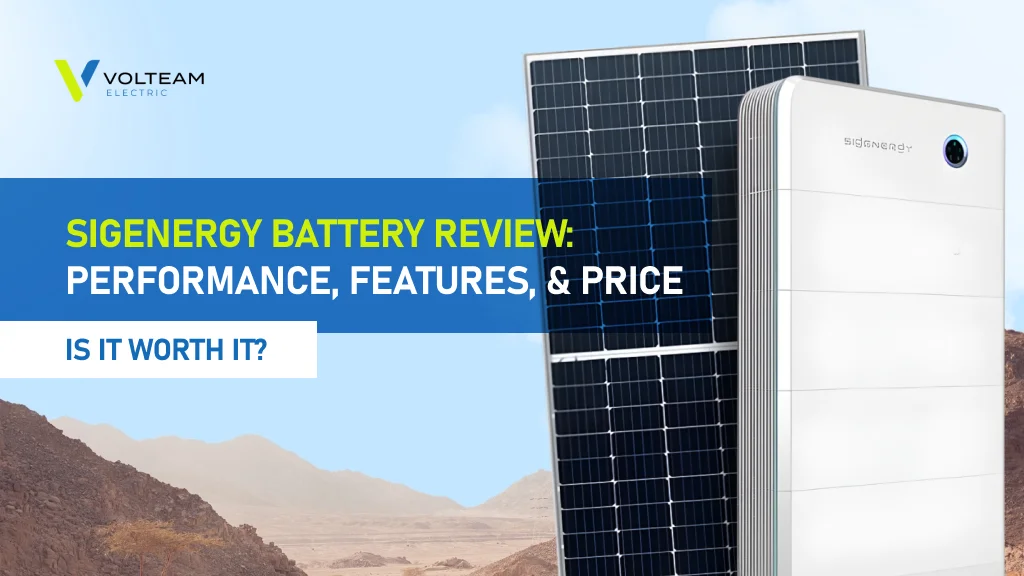
Sigenergy Battery Review: Performance, Features, Price & Is It Worth It?
Been thinking about adding a battery so that you’re capturing more of your rooftop solar? Just looking to ride through blackouts? Whether you’re planning an entire solar-plus-storage system, expanding an existing array or comparing premium batteries for a commercial site, Sigenergy has probably popped up on your research radar.
Sigenergy has moved fairly quickly from “new name” to serious contender since their system is modular and designed around energy management rather than just storing electrons.
So, throughout this Sigenergy battery review, we’ve broken down what you’re actually getting with the SigenStor platform. Both for Australian homes and businesses. We’ll be looking at:
- The most important specs
- Our own installations
- Current 2026 pricing
- How the numbers stack up
- Where we see the best return on investment
What is the Sigenergy Battery?
Sigenergy is an energy-tech company, and it was founded in 2022. We’d normally prefer older, more experienced companies, but Sigenergy is run by the engineers who previously led Huawei’s inverter division.
So, in just four years, the firm has ended up shipping more than 300 MWh of storage across 40 countries. They’ve also established an R&D centre in Melbourne to localise its software for the National Electricity Market.
The company’s flagship product is the SigenStor, which includes the following in just one minimalist tower:
- A high-efficiency hybrid inverter
- Lithium-iron-phosphate (LFP) battery modules
- An EV DC-charger sloth
- An AI-powered Energy Management System (EMS)
Now, one thing we like about the SigenStor is how the inverter, gateway, and EMS are pre-configured. This means you avoid any compatibility headaches and can keep conversion losses low. But it’s also one of the reasons why SigenStor is viewed as a fairly premium option in Australia’s crowded battery field.
Sigenergy Battery Models Available in Australia
What are the main options you’ve got with Sigenergy? It’s these two module sizes – 6 kWh (105 Ah) and 8 kWh (135 Ah). Both of these use prismatic LFP cells. That essentially just means they’re safe.
So, each of these towers accepts up to six modules, which means usable capacity scales between 6 kWh and 54 kWh without external cabling.
Also, the base includes either a 5 kW single-phase inverter or a 10-30 kW three-phase inverter, which makes the same hardware suitable for a suburban home or a small winery. And because the inverter is hybrid, SigenStor can connect on the DC side of new panels or in AC-coupled mode to an existing array, which means you won’t have to invest in anything new to put it to use!
Sigenergy Battery Performance Review
Laboratory testing by TÜV Rheinland and thousands of live cycles recorded in the Sigenergy cloud put SigenStor’s DC round-trip efficiency at 94-95 %, which is actually about four points higher than the Australian fleet average.
What this means is that you’re only actually losing around 5 cents of every solar dollar stored. Charge and discharge also occur at a powerful 1 C, so an 8 kWh module can supply 8 kW for an hour. That’s handy for induction cooktops or EV fast top-ups!
We also like how the unit continues delivering full output down to -20°C and even up to 60°C, so you’re good in both mountain shacks and terraces in Darwin. What’s more, SigenStor also allows scheduled charging from the grid, which basically means you can arbitrage cheap off-peak tariffs under time-of-use plans.
Get a Sigenergy solar battery installation now – request your solar & battery quote.
Sigenergy Battery Price Australia Guide (2026)
Component | Typical Price |
Hybrid controller (5-30 kW, includes EMS) | $3,500-$9,000 |
8 kWh LFP module | $4,500 each |
Energy Gateway backup switch | $2,990 |
Optional 25 kW DC charger | $6,500-$7,500 |
So, standard metro installation – including everything from labour and switchboard upgrades to compliance testing – can add about $1,500 – $3,000 to the hardware bill.
And if you were going to go with a 16 kWh SigenStor stack (modules + hybrid controller + gateway), you’re looking at around $13,000 – $15,000.
Now, what’s worth mentioning is that the federal Cheaper Home Batteries rebate still pays up to $372 per kWh for installs completed before the 1st of May 2026 (dropping to about $300 / kWh thereafter, so you’ve still got time). And on 16 kWh of usable capacity, that is a $5,900 – $6,000 subsidy, which would actually cut your out-of-pocket cost to roughly $9k – $11k.
Ultimately, you’re looking at a payback of just 7-10 years. But of course, all the prices we’ve touched on here are super specific to certain stack configurations. The only way you can get an accurate figure – installation included – would be to get a quote from Volteam!
Key Features & Benefits
- Smart Energy Management: The system is designed to manage everything from charging and discharging to solar use and backup reserve, so more of your stored energy is used where it actually matters.
- Scalability and Expandability: Sigenergy is modular, meaning you don’t need to overspend upfront on more battery capacity than you need.
- Backup Power Capability: You’re getting a strong option if you want that added protection during outages.
- Monitoring and App Integration: The mySigen app gives you a clear view of everything from solar generation and battery usage to charging behaviour and household consumption.
Sigenergy Battery Warranty & Reliability
Sigenergy’s standard 10-year product and performance warranty guarantee at least 70% of original usable energy or 9.6 MWh throughput per 8 kWh module, whichever comes first.
That actually equates to roughly 6,000 full cycles, which means you’re getting over 15 years of typical daily use!
So, the hardware itself is well specified, but because Sigenergy is still a younger brand than some legacy players, installer quality and local support matter more than ever, which is what you’re getting with Volteam.
Sigenergy Battery vs Other Batteries
Let’s look at a few of Signenergy’s competitors to see if this premium brand actually stacks up against other solar batteries:
Metric | Sigenergy SigenStor 16 kWh | Tesla Powerwall 3 13.5 kWh | SolarEdge Home Battery 10 kWh |
Round-trip efficiency (DC) | 95% | 89% | 94.5% |
Depth of discharge | 100% | 100% (adjustable) | 100% |
Continuous discharge (on-grid) | 10 – 12 kW (model range) | 10 kW (configurable up to 11.5 kW) | 5 kW |
Warranty | 10 yr / 70% | 10 yr / 70% | 10 yr / 70% |
Installed price (before rebate) | $15 – 17 k | $12 – 14 k | $12 – 13 k |
Again, these prices are going to vary with switchboard work and installer margins, so this list is mainly just to show current metro averages.
Compare solar and battery
Compare the best solar solutions for your home in one place. Use our tool to evaluate batteries, solar panels, EV chargers, and inverters. Start comparing today!
Should You Choose Sigenergy?
Choose Sigenergy if you:
- Need more than 13.5 kWh of storage today or foresee adding capacity later.
- Live in an area with frequent outages and want a near-instant switchover.
- Plan to charge an EV quickly from solar using the optional DC module.
- Prefer a single-vendor stack so you’ve got fewer future maintenance headaches.
Installation Example
Let’s run a few numbers to see what you can expect:
- A household with a 10 kW solar system and high evening usage adds a 15.6 kWh Sigenergy battery.
- Installed cost might land around $15,000 to $18,000 – it just depends on the gateway and switchboard work.
- Before battery storage, the home imports about 22 kWh per day from the grid in shoulder and peak periods.
- After installation, that may fall closer to 6 to 9 kWh per day if daytime solar production is strong.
- On a blended avoided import rate of 30 to 35 cents per kWh, annual bill savings can be roughly $1,400 to $1,900.
Is the Sigenergy Battery Worth It?
For the right buyer, yes. Now, this is not the cheapest battery on the market, but price alone is not the point. You’re paying for:
- Integration
- Flexibility
- Strong backup potential
- Premium control software
The ROI is acceptable rather than spectacular, but the value is a lot clearer if you care about blackout protection or lower grid reliance, for instance. Also, every extra kWh of solar you store and use on-site cuts reliance on grid electricity and reduces wasted daytime exports!
Why Choose Volteam?
- Accredited Installers: We install to industry standards, with qualified workmanship and system setup done properly from day one.
- Custom System Design: We size every solar and battery system around your property and goals.
- Rebate Assistance: We help you understand available rebates and incentives so the process is less time-consuming.
- Ongoing Support and Monitoring: We stay involved after installation with support and help if something needs attention.
Frequently Asked Questions
Is Sigenergy a good battery for Australian homes?
Yes, especially for buyers wanting modular sizing and premium monitoring.
What is the Sigenergy battery price in Australia?
Installed pricing varies a lot, but most residential systems sit from the low $10,000s upward, depending on the size and complexity.
Can Sigenergy work with existing solar?
Yes, it’ll work in a lot of retrofit scenarios, but compatibility is going to depend on the inverter setup and whether additional Sigenergy hardware is required.
Is Sigenergy good for backup power?
Yes. With the correct gateway and design, it provides seamless backup switching and strong outage performance.
Ready for a Personalised Quote?
Access solar deals and offers from Volteam and we will show you whether a Sigenergy system makes sense for your home or business!