

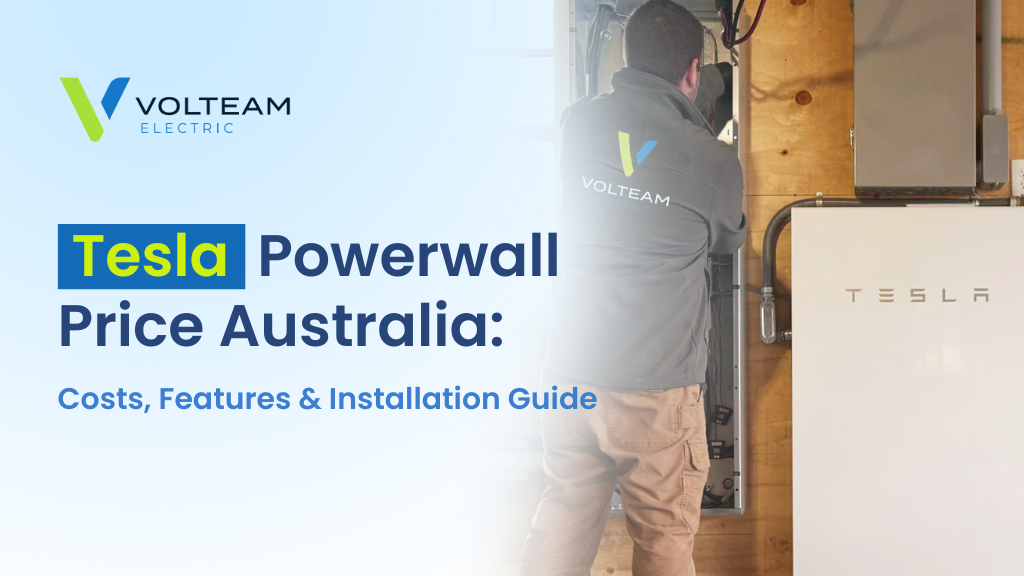
Tesla Powerwall Price Australia: Costs, Features & Installation Guide
Power bills keep climbing, the feed-in tariff you get for exporting solar keeps shrinking, and every storm season brings another round of blackouts. If you already have solar panels on the roof, you are probably watching cheap daytime power flow back to the grid for a few cents while you buy it back at peak rates each evening.
A Tesla Powerwall is built to fix exactly that, by storing your own solar power so you can use it after dark.
The first question almost everyone asks is the price. In this guide we break down what a Tesla Powerwall costs in Australia in 2026, what goes into the installed price, how the federal battery rebate lowers it, and what makes the final figure go up or down for your home.
Every price here is a market estimate that will vary with your site and the day you get quoted, so treat the ranges as a guide and confirm the real number on an itemised quote.
How Much Does a Tesla Powerwall Cost in Australia? (2026)
A Tesla Powerwall 3 typically costs around $13,500 to $16,500 fully installed in Australia in 2026, or roughly $10,000 to $13,000 after the federal battery rebate. The hardware on its own sits near $11,200 to $13,250 for the unit, plus about $1,950 for the required Backup Gateway, with installation adding the rest.
Those are ballpark ranges for a single Powerwall on a standard home. The exact figure depends on your switchboard, whether your home is single or three-phase, and how much backup you want. Here is the quick view.
| Item | Approx. price (AUD) |
| Powerwall 3 unit (13.5kWh) | $11,200 – $13,250 |
| Backup Gateway 2 | ~$1,950 |
| Installation | $1,500 – $3,000 |
| Total installed (single unit) | $13,500 – $16,500 |
| After federal rebate | ~$10,000 – $13,000 |
Prices are estimates only and will vary by home, location, and install complexity. For a figure built around your roof and switchboard, get a free Powerwall quote with Volteam or call 1300 865 832.
Tesla Powerwall 3 Price Breakdown
It helps to see where the money actually goes, because a single headline price hides three separate costs.
• The Powerwall 3 unit is the battery itself, holding 13.5kWh of usable energy. Because it has a solar inverter built in, you are not paying for a separate battery inverter on top.
• The Backup Gateway is the control unit that manages the switch to battery power and keeps your home running during a blackout. It is required for backup, and adds roughly $1,950.
• Installation covers the licensed electrical work, mounting, wiring, switchboard changes, commissioning, and the app setup. This commonly adds $1,500 to $3,000 over the hardware.
One thing to know up front. The Powerwall 3 has its solar inverter integrated into the unit, so there is no separate inverter line item like you would see with an older battery. That keeps the parts count and the install tidier, which is part of why it has become so popular here.
Tesla Powerwall Specifications and Features
The Powerwall 3 is a single, wall or floor mounted battery designed to run a whole home. These are the specs that actually matter when you are comparing it to other batteries.
| Specification | Tesla Powerwall 3 |
| Usable capacity | 13.5kWh |
| Continuous power output | 11.5kW |
| Battery chemistry | Lithium iron phosphate (LFP) |
| Integrated solar inverter | Yes |
| Solar input supported | Up to 20kW DC |
| Weather rating | IP55 enclosure, IP67 battery |
| Operating temperature | -20C to 50C |
| Scalability | Up to 4 units |
| Warranty | 10 years |
A few of these are worth calling out. The 11.5kW continuous output is high for a home battery, which means a single Powerwall can run heavy loads like air conditioning, an oven, and a pool pump at the same time without struggling.
The LFP chemistry is a safer, longer cycling battery type than the older nickel based cells. And because it is rated to operate from -20C to 50C in direct sun, it suits the Queensland climate without needing a shaded spot.
If some of these terms are new, our solar and energy glossary explains kWh, inverters, and feed-in tariffs in plain English.
Tesla Powerwall 2 vs Powerwall 3: Which Is Right for You?
Tesla still has two Powerwall models in the market, and Volteam installs both. They hold the same amount of energy, but they work differently.
| Feature | Powerwall 2 | Powerwall 3 |
| Usable capacity | 13.5kWh | 13.5kWh |
| Continuous power | 5kW | 11.5kW |
| Solar inverter | Separate inverter needed | Built in |
| Coupling | AC-coupled | DC-coupled |
| Best suited to | Adding storage to an existing solar system with its own inverter | New solar plus battery, or homes wanting higher power output |
The Powerwall 3 is the better fit for most new installs, because the built in inverter makes it cheaper and simpler when you are putting in solar and storage together. The Powerwall 2 still makes sense in some retrofits, where you already have a healthy solar inverter and just want to add a battery beside it. We can tell you which one suits your setup once we see your system.
You can read the full details on our Tesla Powerwall 3 and Tesla Powerwall 2 pages, or browse every brand we install on the solar battery hub.
Scaling Up: Multiple Powerwall Systems
One Powerwall suits a lot of homes, but larger households, all electric homes, and properties wanting longer backup often go bigger. The Powerwall 3 is designed to stack, so you can add units as your needs grow.
| System | Usable capacity | Approx. installed price (AUD) |
| Single Powerwall 3 | 13.5kWh | $13,500 – $16,500 |
| Dual Powerwall 3 | 27kWh | $23,500 – $25,500 |
| Triple Powerwall 3 | 40.5kWh | $33,500 – $35,500 |
A single 13.5kWh unit covers the evening and overnight needs of a typical family. A dual setup at 27kWh suits all electric homes, electric vehicle owners, and anyone who wants to ride through a full evening peak and still have backup in reserve. Triple systems are for large properties and high use households. The rebate applies to multiple units too, up to the program limit, which we cover next.
What Affects Your Tesla Powerwall Price?
This is the part the big comparison sites tend to skip. The hardware price is fixed, but the installed price moves around based on your home. Knowing the levers helps you read a quote properly.
Single-phase vs three-phase power
If your home is three-phase, the install is a little more involved than single-phase, which can add roughly $500 to $1,500. It is not a problem, just a factor in the final number.
Switchboard upgrades
Older switchboards sometimes need an upgrade to meet current safety standards before a battery can be connected. If yours needs work, budget another $800 to $2,500. A site inspection tells you for certain.
How much of the home you want to back up
Backing up your whole home through a blackout takes more wiring and sometimes more hardware than backing up a few essential circuits like the fridge, lights, and internet. More backup means a higher price, so it is worth deciding what matters most to you.
Install complexity
Cable run length, where the battery is mounted, roof and meter access, and how your existing solar is set up all play a part. A clean, simple install costs less than a tricky one.
Because of all this, the only way to get an accurate price is a proper site assessment. Volteam quotes are transparent and itemised, and they are backed by our 30-Day Price Beat Guarantee, so if you find a comparable quote cheaper within 30 days, we will beat it.
The Cheaper Home Batteries Rebate: How Much You Save
The federal Cheaper Home Batteries Program is the main rebate available to Australian homeowners in 2026, and it makes a real difference to the price.
• It cuts around 30 percent off the upfront cost of an eligible battery.
• It is delivered through Small-scale Technology Certificates (STCs) under the Small-scale Renewable Energy Scheme. In plain terms, the government effectively pays for a chunk of the install through tradeable certificates.
• Eligible battery sizes run from 5kWh to 100kWh, with the first 50kWh of a system counting toward support.
• For a single 13.5kWh Powerwall, the discount currently lands around $3,300 to $3,400, though the exact figure floats with the certificate price.
The best part is you do not have to chase paperwork. Volteam handles the STC trade-in as an upfront discount on your invoice, so the saving comes straight off the price rather than arriving later.
Two honest notes. First, the rebate became tiered from 1 May 2026 and steps down over time, so the support is gradually reducing, especially for larger systems. Second, there is no separate Queensland state battery rebate in 2026.
The old Queensland Battery Booster scheme closed in 2024 and has not been replaced, so the federal program is the rebate that applies here. Anyone implying a stacked state rebate on top is not giving you the full picture.
For the current eligibility rules and how the discount is applied, see our Cheaper Home Batteries Program guide.
Is a Tesla Powerwall Worth It in Australia?
For the right home, yes, but it depends on how you use power. A battery pays for itself by storing cheap or free daytime solar and using it at night, so you stop buying expensive peak power and stop exporting solar for a tiny feed-in tariff.
A Powerwall makes the strongest financial case when you already have solar, use a fair bit of power in the evening, and your feed-in tariff is low. In that situation you are wasting the most value by exporting, and a battery captures it. Adding a virtual power plant (VPP), where you let your battery support the grid at peak times in exchange for payments, can shorten the payback further.
It is a bigger stretch if you use very little power, have a high feed-in tariff locked in, or do not have solar yet. In those cases it can still be worth it for the blackout protection and energy independence, just with a longer payback.
The honest answer is that it comes down to your bills and your habits, which is why we model the savings for your specific home rather than quoting a one size fits all payback.
Want to see your numbers? Try our solar savings calculator for an estimate based on your usage.
Tesla Powerwall Installation with Volteam
A battery is only as good as the install behind it, and this is where a local, accredited team beats a national lead form.
Volteam is a licensed Brisbane and South East Queensland electrical contractor, QLD Electrical License #72286, CEC accredited, with more than 5,000 Brisbane homes served and over 10,000 installations completed. We are rated 5.0 on Google.
Every Powerwall install includes the licensed electrical work, the Backup Gateway setup, commissioning, app configuration, and a walkthrough so you know how to use it.
Because we are based here, we know the local network rules, the switchboard standards, and the realities of installing in the SEQ climate. And every quote is itemised, transparent, and backed by our 30-Day Price Beat Guarantee.
Ready for a real figure? Get a free Tesla Powerwall quote with Volteam or call 1300 865 832 to talk to a CEC-accredited installer.
Frequently Asked Questions
How much does a Tesla Powerwall cost in Australia in 2026?
A single Powerwall 3 typically costs around $13,500 to $16,500 installed, or roughly $10,000 to $13,000 after the federal Cheaper Home Batteries rebate. The final price depends on your switchboard, phase type, and how much backup you want, so confirm it on an itemised quote.
Is the Powerwall 3 worth it compared to the Powerwall 2?
For most new installs, yes. The Powerwall 3 has a solar inverter built in and a much higher 11.5kW power output, which makes it cheaper and simpler when installing solar and storage together. The Powerwall 2 can still suit a retrofit where you already have a working solar inverter.
Does the Powerwall 3 work with my existing solar?
Yes. A Powerwall can be added to an existing solar system, and we will check your inverter and switchboard to confirm the best way to connect it. In some cases a Powerwall 2 retrofit suits an existing setup better, which we will advise on after a site assessment.
How long does a Tesla Powerwall last?
The Powerwall 3 comes with a 10-year warranty. Its lithium iron phosphate cells are designed for daily cycling, so it is built to be charged and discharged every day across that warranty period and beyond.
Can a Tesla Powerwall power my whole house in a blackout?
It can, depending on how it is set up. With the Backup Gateway, a Powerwall keeps your home running when the grid goes down. Its 11.5kW output is enough to run heavy appliances, though backing up the whole home rather than essential circuits affects the install and the price.
Can I install multiple Tesla Powerwalls?
Yes. The Powerwall 3 is designed to stack, so you can install up to four units for more storage and longer backup. The federal rebate applies to multiple units up to the program limit, which makes a larger system more affordable than the raw hardware price suggests.
Conclusion
A Tesla Powerwall turns the solar you already generate into power you can use after dark, which is where the real savings sit now that feed-in tariffs have fallen. Expect a single unit to land around $13,500 to $16,500 installed, or near $10,000 to $13,000 after the federal rebate, with the exact figure shaped by your home.
The smartest next step is a proper quote built around your roof, your switchboard, and the way you use power. Get a free Tesla Powerwall quote with Volteam, explore your options on our solar battery page, or call 1300 865 832 to speak with a CEC-accredited local installer. Every quote is transparent, itemised, and backed by our 30-Day Price Beat Guarantee.