

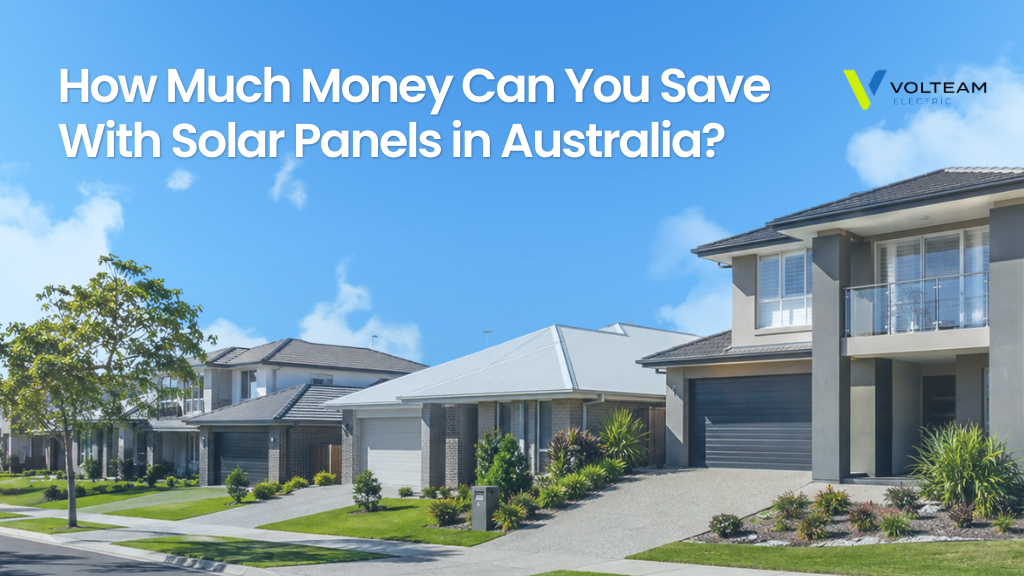
How Much Money Can You Save With Solar Panels in Australia?
A Brisbane home with a mid-sized solar panel system typically saves about $1,100 to $1,700 a year on electricity (an estimate). The range is wide because the savings depend on how much of the power you make you use at home rather than on how much your roof produces.
So if you’ve searched how much money you save with solar panels Australia-wide, the short answer for a 6.6 kW system is about $1,100 a year if you’re out all day and up to $1,700 if someone’s home in the daytime (estimates). Many Brisbane homes recover the upfront cost in roughly 3 to 6 years.
This guide breaks the maths into steps and then runs a worked example for a typical South East Queensland home. You can swap in your own numbers as you go.
How Much Money Do You Save With Solar Panels in Australia Each Year?
Most Brisbane homes save roughly $1,100 to $1,700 a year, and savings vary significantly depending on these factors:
- How much of your daytime power you use yourself.
- The size of your system.
- Your roof direction, tilt, and shading.
- The price you pay for each unit of electricity.
- The rate your retailer pays for power you export.
- Your upfront costs after the government discount.
How Solar Panels Cut Your Electricity Bills and Energy Costs
Panels only produce while the sun is up. Any unit you run straight away is a unit you don’t buy from the grid, which is the network of poles and wires that supplies your home.
Electricity is sold by the kilowatt-hour (kWh), the amount of energy a 1,000-watt appliance uses in one hour. Most homeowners can find their price on a recent bill, and many Brisbane households pay between 28 and 35 cents per kWh (an estimate).
Each kWh your panels supply directly to your house saves you that full price, so a solar panel system pulls down power bills at the source. Your energy costs never reach zero because the bill still carries a daily supply charge for being connected. Even so, solar delivers substantial savings on your energy bills.
What happens to excess energy you don’t use?
Panels produce the most around midday, often when nobody’s home. Any excess energy your house can’t use flows back to the grid, and your retailer pays you a feed-in tariff for it. In South East Queensland, each retailer sets its own rate, and offers commonly sit in the single digits of cents per kWh (an estimate).
The two prices explain almost everything. Using a kWh yourself saves around 30 cents, while exporting it earns perhaps 6 cents. Using your solar power beats selling it by a factor of about five.
Cost Savings Examples with a 6.6 kW Solar Panel System
Here’s the same 6.6 kW system on three different households. The “kW” figure is the system size, meaning the maximum output of the panels. The sums use these assumptions, all estimates:
- The panels produce 8,500 kWh a year. Official sunshine ratings for Brisbane suggest about 1,380 kWh per kW of panels, and we’ve taken off roughly 7% for losses in the wiring and the inverter (the box that converts panel output into household power).
- You avoid paying 30 cents for every kWh you use from the panels.
- You earn 6 cents for every kWh you export.
| Home A: out all day | Home B: mixed days | Home C: home in daytime | |
| Share of solar used at home | 30% | 45% | 60% |
| Solar used at home | 2,550 kWh | 3,825 kWh | 5,100 kWh |
| Bill saving at 30c per kWh | $765 | $1,148 | $1,530 |
| Solar exported | 5,950 kWh | 4,675 kWh | 3,400 kWh |
| Export credit at 6c per kWh | $357 | $281 | $204 |
| Estimated yearly total | $1,122 | $1,428 | $1,734 |
Same roof, same panels, and a big difference in the result, worth more than $600 a year. To run your own version, multiply the kWh you use from the panels by your price per kWh, then add the kWh you export multiplied by your export rate.
How Does Energy Use Impact Costs?
Two neighbours can install identical systems and see very different results on their power bills. The cause is almost always the household, not the hardware.
- Daytime energy use sets how much you keep
If someone is home on weekdays, the fridge, air conditioner, pool pump and laundry all draw power while the panels are producing. Running the dishwasher and washing machine in the sunny hours turns exported kWh into avoided ones, and it’s the most efficient change most households can make. Our guide to saving money on electricity at home covers appliance habits in detail.
- Energy consumption that grows with your household
Your energy needs today may not match the next ten years, since energy consumption tends to climb as a household grows. A second fridge, a pool, a work-from-home setup or an electric vehicle will all use more electricity during daylight hours, and a system sized only for today can feel small in the future. Tell your installer what’s coming, because it shapes what the right system size is for the house.
System and Installation Costs, and Your Payback Period
The payback period is the time your savings take to cover your upfront costs. Divide what your system cost comes to after the government discount by your yearly savings. As a rule of thumb, every $1,000 of upfront costs takes roughly 7 to 11 months of savings to recover at the range above.
Many Brisbane homes last somewhere around 3 to 6 years (an estimate), and the panels keep working long after that. In the long run, everything after payback is saving. Our solar panel cost guides cover current system prices, so we’ve kept them out of this article.
Why homeowners choose to install solar panels
The reasons usually fall into a few groups:
- Predictable bills when grid prices rise
- Lower carbon emissions from the electricity the home uses
- More control over when and how power is used
- A system that works harder once an EV charger or a heat pump joins the home
Bill certainty tends to decide it. Installation costs are paid once, and the benefits turn up on every bill after that.
Government Incentives That Lower Your Upfront Costs
The main government incentive for rooftop panels is federal. When you install panels, your system earns small scale technology certificates (STCs), and each one represents 1 megawatt-hour (1,000 kWh) of clean energy the system is expected to generate. Your installer sells them and passes the value to you as a discount on your quote.
The number of STCs comes from your system size in kW, multiplied by your area’s sunshine rating, multiplied by the number of years the scheme still has to run. For a 6.6 kW system in Brisbane installed in 2026, that works out at about 45 STCs. At roughly $38 to $40 each, that’s a discount of about $1,700 to $1,800 (an estimate, because certificate prices move).
The number of years drops by one each calendar year, and the scheme closes at the end of 2030. A system installed in 2027 would earn about a fifth fewer certificates than the same system today.
How do government rebates apply in Queensland?
For rooftop panels, this federal discount is the one that applies to a Brisbane home. Rebates and interest-free loans you may see advertised for South Australia or New South Wales aren’t available here. A separate federal program discounts eligible batteries upfront, and the battery guides cover how it works. Ask your installer to confirm what’s on offer on the day you get your quote.
How to Increase Your Long-Term Savings from Solar Panels
Most of the long-term savings come from a handful of key factors that you control before the panels go up.
- Pick efficient panels
Solar cells are the silicon squares inside each panel, and higher efficiency panels turn more sunlight into power from each square metre. That means more energy from a small or shaded roof.
The panel type you choose changes how much power fits on your roof. Premium panels usually lead on efficiency, though high quality panels in the mid-range can serve a roomy roof well. Panel quality also decides how slowly output fades over the years, which keeps your potential savings intact.
- Choose the right system size for your daytime use
The right system suits your daytime load first. A larger system generates more electricity, but the extra kWh around midday mostly get exported at the low rate. Homes with high daytime use, a pool or an electric vehicle often justify going bigger.
- Get a solar battery to store excess energy
A solar battery lets you store excess energy from the afternoon and use it in the evening instead of exporting it. That swaps a 6-cent export for a 30-cent saving. It’s an optional add-on with its own costs, so some households invest in one later, and size and lifespan are better judged separately.
- Pick an accredited retailer and payment plan
Your retailer sets your export rate and your price per kWh, so a quick plan comparison can change the result. One option in South East Queensland is the Solar Sharer Offer, an opt-in plan that gives free power from 11am to 2pm each day. The questions below look at who it suits.
- Choose a reputable installer
Reputable installers design the system around your roof and your usage, then stand behind the work. Warranty terms matter just as much, since they protect the output you’re counting on year after year.
Save Money with Solar Panels from Volteam
Solar works like an investment that pays you back on every bill. After the payback period, the long-term benefits are lower energy costs for the life of the panels and less exposure to grid price rises.
Volteam is a licensed Brisbane electrical contractor. We design and install solar for homeowners across Brisbane and South East Queensland.
The sums in this article are only as good as the numbers behind them. Bring a recent power bill and we’ll run the same maths on your daytime use, your roof and your plan. A savings calculator on our website gives you a quick first look before we talk.
Frequently Asked Questions
Will I still get an electricity bill after installing solar?
Yes. You’ll still pay the daily supply charge, plus any power you buy after dark or on cloudy days. Many solar homes see their bills fall a long way, but the connection fee stays.
How does my roof type change what I save?
Your roof type sets the direction, tilt and shading your panels face. North-facing panels generally produce the most across a year. A roof facing east or west gives up a little yearly output, though it moves production towards the morning or the afternoon, which can suit households that are busy at those times.
Is the Solar Sharer Offer worth it with solar panels?
It depends on when you use power. The offer gives up to 24 kWh of free electricity between 11am and 2pm, but it needs a smart meter, and prices at other times of day can be slightly higher. Compare it against your own usage and the export rate on your current plan.
What do warranty terms mean for my savings?
Panels usually carry two separate promises. A product warranty covers faults, and a performance warranty covers how much output the panels must still deliver as they age. Check the length of each, and ask who handles claims if your installer is unavailable.
Do savings drop in winter?
Output dips in winter because the days are shorter and the sun sits lower. Brisbane’s clear winter skies keep panels productive, and each kWh you use still saves the same price. Judge the system on the full year, not a single month.