

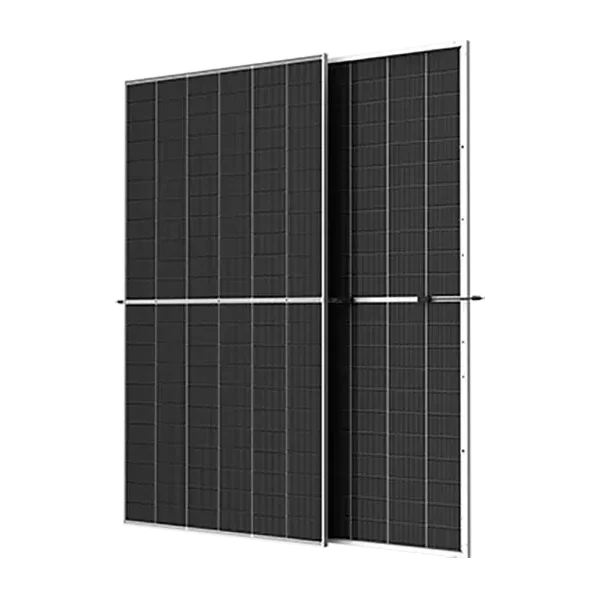
475W out of a panel that covers about two square metres of roof. That is the whole reason to shop the Trina Vertex S+ instead of a standard module. You fit more capacity into the same space, and a tight or cut-up roof stops being the thing that caps your system size.
Behind the front glass sit 96 N-type i-TOPCon Ultra cells. They run at up to 23.7% efficiency and hold their output better as the roof heats up, which is the part that shows on a power bill through the summer months.
Standout Features
- Anti-reflective coating on the front glass, which pulls in more of the light arriving at a low angle early and late in the day instead of bouncing it back off the roof.
- Power tolerance sorted to -5W and +10W, so the panel that turns up measures within a few watts of the number on the label rather than somewhere under it.
- 1500V DC maximum system voltage, which lets a string run longer before it hits the ceiling and keeps the number of separate strings, and the cable that goes with them, down.
- Lightweight 21.0kg across 1762 x 1134mm, a modest load to add to a roof that also has to carry rails, feet, and a summer of wind.
- 30mm anodised aluminium frame, coloured through the anodising rather than painted over the top, so weathering does not turn up as a chalky edge in five years.
- Class C fire safety, Safety Class II, and certification to IEC 61215 and IEC 61730, which are the mechanical and electrical test regimes a panel has to survive before it can be sold here at all.
Who Is This Product For?
- Roofs where the usable area runs out before the budget does. Hips, vents, and skylights break a roof into short runs, and a higher-output module lets each of those runs carry more capacity than it otherwise would.
- Systems that will be asked to do more in a few years. A battery or an EV added in three years pulls far more out of an array than today’s bill suggests, and starting on a higher-output panel leaves that headroom on the roof you already have.
- Older arrays with roof space still left over. A system installed five years ago is likely running 330W to 370W modules, so a modest number of these lifts total output without new racking down the length of the roof.
- Households that use most of their power in daylight. Pool pumps, ducted air conditioning, and a car charging through the afternoon all reward a bigger array, and 75W per panel over a 400W module compounds across every string.
- Arrays that will be seen from the street. The all-black frame and dual glass finish reads as one dark rectangle rather than a grid of silver lines and pale gaps.