

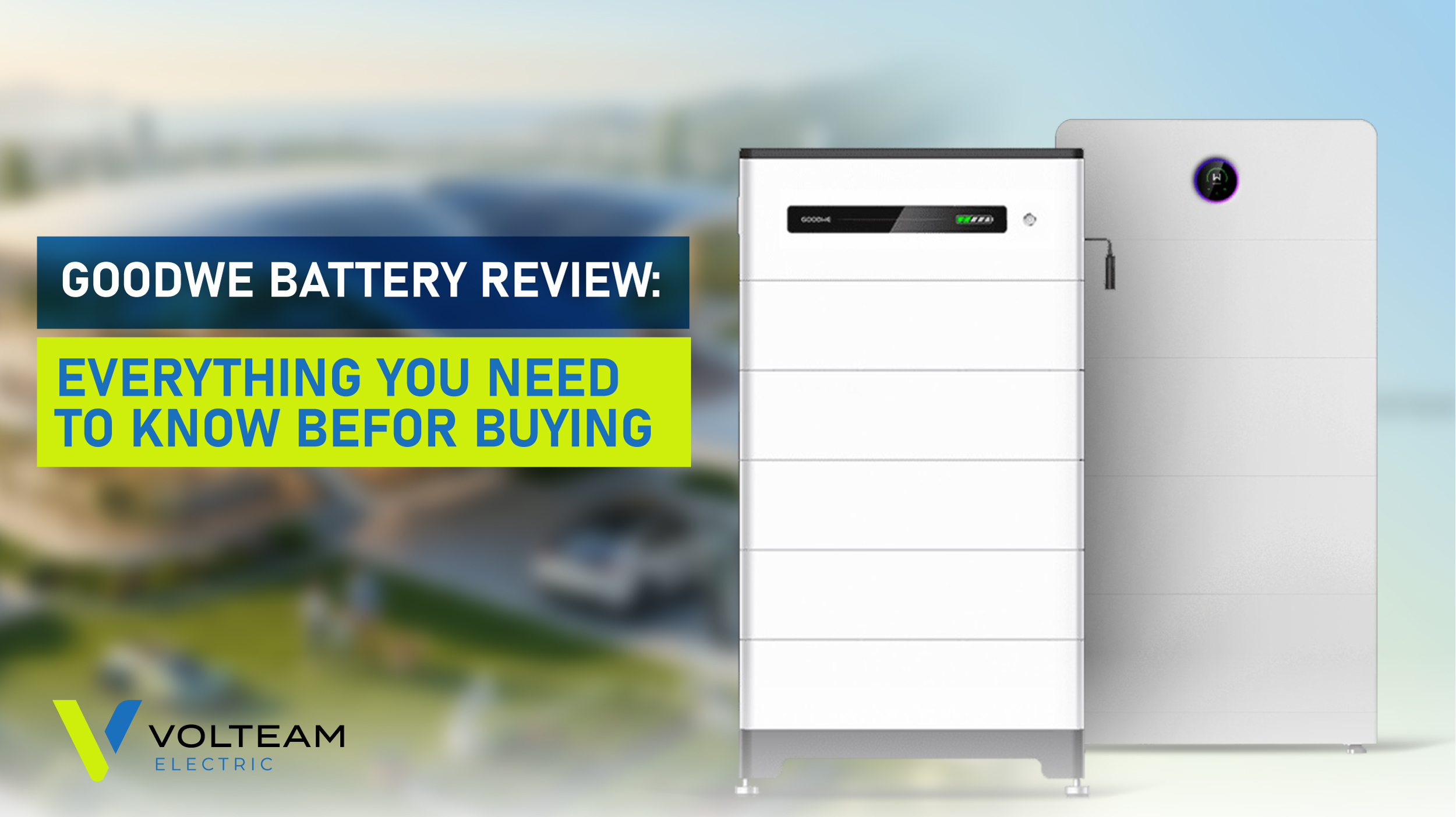
GoodWe Battery Review: Everything You Need to Know Before Buying
Concerned about blackouts and want a more reliable way of storing power? Been watching your electricity bills creep up, so you think it might be time to switch to a solar battery? We’re seeing loads of Australian homeowners doing the same thing, but how are you meant to know which battery to choose?
GoodWe has been getting a lot of attention lately since they’re probably one of the best, most value-driven options out there. So, in this GoodWe battery review, we’re going to walk you through everything:
- The models
- The pricing
- What the warranty actually covers
- Whether it makes sense for your home
What is a GoodWe Battery?
GoodWe was founded in 2010 in Suzhou, China – not the oldest company in this market, but still old enough to have built up a decent reputation. They mainly did that by making solar inverters – reliable, affordable alternatives to the big European names – and they’ve been operating a local office in Australia since 2012.
That local presence means you’ve actually got someone to call when things go wrong, but you can always get that support with Volteam, too.
GoodWe got involved in the battery market in 2021 with its first Lynx home battery and have been developing the range ever since. In April 2025, they launched what’s arguably their most impressive product to date at the Smart Energy Conference in Sydney: the ESA Series. It’s a big step up, and we’ll get into why shortly.
GoodWe Battery Models Available in Australia
Right now, GoodWe’s residential lineup has a few different series worth looking at. Each of these is suited to different setups.
Lynx Home U Series
The Lynx Home U Series is your low-voltage, modular option, and it starts at 5.4 kWh and scales up to 32.4 kWh if you want to add modules. We like that it’s plug-and-play in its design, but keep in mind it works exclusively with GoodWe hybrid inverters.
More importantly, though, you’ll struggle to find better value if you’re looking to start small and expand later.
Lynx Home F Series
The Lynx Home F Series then steps things up a bit with high-voltage architecture, as it covers 6.6 kWh to 16.4 kWh of usable capacity.
It’s undoubtedly faster to charge and discharge than the U Series, so we’d usually recommend this one if your house has quite high daily consumption.
Lynx F G2
The Lynx F G2 is GoodWe’s next-generation high-voltage battery in the Lynx series. We like that it’s improving the cycle life and charging speeds compared to the previous two. And you can get quite granular with sizing, with the latest modules being around 3.2 kWh each. It covers 6.4 kWh all the way up to 28.8 kWh per stack.
ESA Series
The flagship one is the ESA Series – this is an all-in-one system that integrates:
- The inverter
- Battery modules
- Energy management hardware
That’s all in one cabinet. The modules come in either 5 kWh or 8 kWh, and the system scales up to 48 kWh. We like that it’s retrofit-friendly, which makes it solid whether you’re building a new system or upgrading an existing one.
GoodWe Battery Price Guide (2026)
Pricing in the battery market moves around, but here’s a reasonable picture of what you’re looking at with GoodWe:
Average Price Range
For a 10 to 13.5 kWh GoodWe Lynx Home U system installed, expect to pay roughly $10,000 to $16,000 before any rebates. But that range gets a bit lower if you’re adding to an existing compatible GoodWe inverter setup. If you also need a new hybrid inverter, add somewhere between $1,500 and $3,000.
The good news is that the Federal Cheaper Home Batteries Program is still a solid way of saving a bit of money here – at roughly $300 per kWh of eligible capacity, a 10 kWh installation could see around $3,000 knocked off upfront.
For the ESA Series, you’re looking at around $955 per usable kWh – which puts it at the more competitive end of the market, especially given everything that’s packed into the one cabinet.
Installation Costs
Installation adds to the total, too, which is about $1,500 to $3,000, depending on your switchboard and how much cable run is involved. You can get a clearer sense of what affects these figures in our solar battery installation cost guide.
ROI
Combined with solar generation and smart load shifting, you’re looking at a payback period somewhere in the 7 to 12 year range, which is fairly reasonable for a system expected to last 15 years or more.
Key Features and Benefits
The thing that stands out across GoodWe’s range is the round-trip efficiency, which is about 95 to 96% across most models. This is important since it means you’re losing barely any energy in the charge-discharge cycle, which matters when you’re relying on stored solar energy day in, day out.
The ESA Series specifically brings a few noteworthy additions:
- There’s a six-layer safety system, with features like fault detection and aerosol fire suppression built into the unit itself
- Backup switching kicks in at under 4 milliseconds (so you don’t notice a grid outage)
- The whole system is IP66-rated
- You have smart monitoring through the GoodWe SEMS app and portal
- There are remote firmware updates, which means the system improves over time without needing a technician
Pros and Cons of GoodWe Batteries
Pros
- Established brand presence
- Strong support
- Competitive pricing
- LFP chemistry
- Modular design
Cons
- GoodWe directs customers to contact them directly instead of disclosing the maximum rates it covers for warranty publicly
- The GoodWe monitoring app isn’t as polished as some competitors.
Who Should Choose a GoodWe Battery?
GoodWe is a strong fit for anyone wanting solid performance at a reasonable price point without stretching your budget. And if you already have a GoodWe hybrid inverter installed, pairing it with a Lynx or ESA battery is seamless.
Got a small house and only use around 15 to 25 kWh per day? You’ll find that mid-range Lynx configurations are all you need. It‘s also worth considering for anyone who wants to start with a single battery module now and add capacity later as finances allow.
If you’re still figuring out how to choose the right solar battery for your property, it’s worth reading up on the key specs – usable capacity, power rating, battery chemistry – before comparing brands.
How it May Look in Practice
- Scenario: Brisbane home, 6.6 kW solar already installed, ~22 kWh daily usage, high evening grid imports
- Cost: GoodWe Lynx F G2 at 12.8 kWh installed ~$12,500 before rebate, ~$8,700 after
- Results: Grid imports drop significantly, estimated savings of $1,400 to $1,800 per year, payback around 6 to 8 years
Why Choose Volteam for Your GoodWe Installation
At Volteam, our CEC-accredited installers handle hybrid solar and battery systems daily. We size systems based on your actual usage data rather than a rough estimate, which makes a huge difference to how quickly your investment pays off.
We also manage the paperwork for everything from rebate eligibility and grid connection to compliance, so you don’t have to handle that process alone.
And we’re always around for additional support after we’ve installed your new battery. For instance, if a firmware update causes a performance issue or you want to expand your storage down the track, you’ve got someone to call who already knows your system!
FAQs
Is a GoodWe battery worth it?
GoodWe batteries are worth it for most Australian households pairing it with solar. The pricing is competitive, the LFP chemistry is reliable and the local support infrastructure is meaningfully better than loads of newer brands out there. The federal rebate also makes the upfront cost easier to absorb right now, although this only lasts (in its current form) until the 1st of May 2026.
How long does a GoodWe battery last?
GoodWe’s batteries last for 6,000 or more charge-discharge cycles. At one full cycle per day, that would translate to roughly 15 or more years of use. The 10-year warranty guarantees at least 70% capacity retention, which gives you a fairly reasonable baseline to plan around.
Is GoodWe reliable in Australia?
GooWe has a track record of being reliable – they’ve been operating in the Australian market since 2012 and have a local office in Rowville, Victoria. Their inverters have accumulated a strong reputation with installers here, such as Volteam, and their battery range is CEC-approved and eligible for federal rebates.
Does GoodWe work with other inverters?
The Lynx series is primarily optimised for GoodWe hybrid inverters. The compatibility with third-party inverters is fairly limited, so you should always confirm it with a qualified installer before committing.
What’s the difference between the Lynx and the ESA Series?
The Lynx batteries are modular storage systems that pair with a separate GoodWe hybrid inverter. The ESA Series is an all-in-one unit that integrates the inverter and batteries into a single cabinet. The ESA is generally better suited to new installations or full system replacements, while the Lynx is often the more practical choice for adding storage to an existing GoodWe inverter setup.
Get in touch with Volteam for a free consultation and battery quote!