

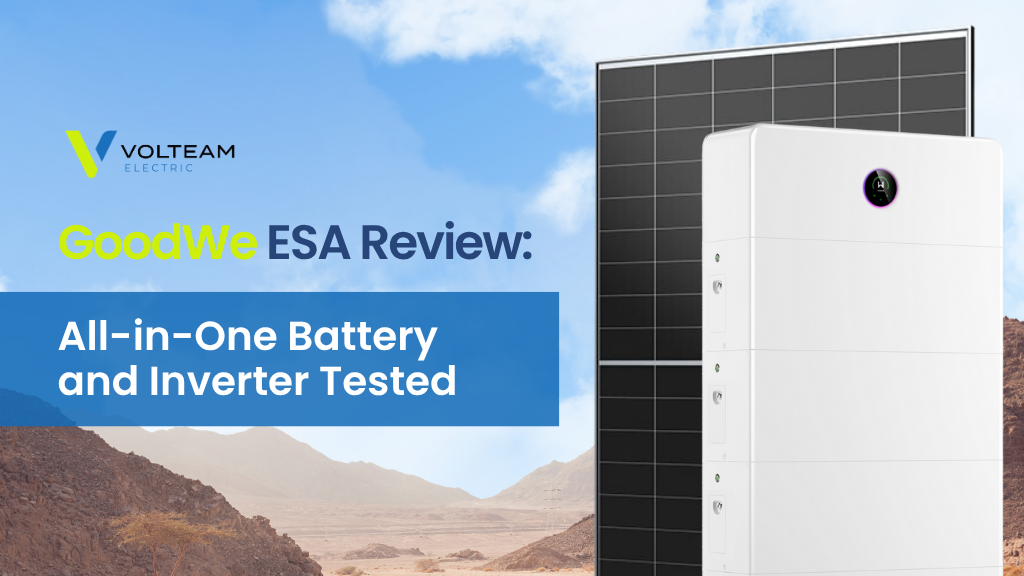
GoodWe ESA Review: The Battery, the Inverter, and the Package
We install a lot of GoodWe gear, and the ESA Series is the one that gets the most questions, mostly because it is not really “a battery” in the usual sense.
GoodWe built the inverter into the same enclosure as the battery, so you are buying a single integrated storage system rather than a battery you then have to match to a separate inverter. Handy, right?
GoodWe was founded in 2010 and is listed on the Shanghai Stock Exchange, before the company expanded steadily in the Australian market, offering initially standard inverters then full home batteries and now this all-in-one format they’ve called the GoodWe ESA.
This GoodWe ESA review covers three parts: the battery on its own merits, the inverter built into it, and what you get from the package as a whole.
We’ve also drawn from our genuine experience installing the GoodWe ESA battery and inverter in real Brisbane homes, from compact Queenslanders with a narrow side passage for wall mounting to larger acreage properties where a bore pump and workshop equipment mean the backup has to cover more than the main house. So you can bet we know how the GoodWe ESA performs.
GoodWe ESA Series: Key Features, Performance & Pricing
- GoodWe’s ESA Series puts a hybrid inverter and LFP battery in one enclosure, so there is one box to mount, one warranty to manage and one app to monitor.
- Usable capacity runs from 5 to 8kWh per module, stacking to 48kWh, which covers most Brisbane homes without needing a second unit.
- The built-in inverter supports 200% PV oversizing, and its transfer to battery backup takes under 4 milliseconds, fast enough that most households never notice the outage.
- Max efficiency sits at 97.5 to 97.6%, competitive with any hybrid system we install.
- It carries a 10-year warranty with capacity guaranteed to at least 70% over that term, backed by GoodWe’s Australian support network.
- Hardware pricing typically runs from around $5,000 for a single 8kWh module to $13,000 or more for a full stack, before the federal battery rebate.
First Up: Let’s Review the GoodWe ESA Battery
Strip the inverter out of the conversation and the ESA Series is a solid LFP home battery, and a genuinely flexible option for how you build a system. GoodWe builds it in 5kWh and 8kWh modules, and lets you mix old and new modules in the same stack as you add capacity, which matters if you start with one module now and want to add another once the family’s power use grows.
That modular design means a single stack takes up to six modules for 48kWh of usable energy, the maximum capacity most Brisbane homes will ever need, and you can run six stacks in parallel if a job genuinely calls for it, though we rarely see a residential install go past two stacks.
GoodWe’s own spec sheet rates the cells for 8,000 to 10,000 charge cycles, well past what most batteries in this class publish, comfortably outlasting the 10-year performance warranty the battery ships with, and supports a 1C charge and discharge rate, fast enough for a full module to cycle in around an hour when the household draw calls for it.
The cell chemistry is lithium iron phosphate, the same family Tesla and Sungrow use in their current-generation batteries, chosen because it tolerates Queensland heat and daily deep cycling without the thermal risk older lithium chemistries carry.
Like any solar battery running at high voltage, it is not a DIY job, which is exactly why it requires a CEC-accredited installer’s licence, not just an electrician’s.
GoodWe ESA Battery Safety Features
GoodWe backs the battery with six layers of protection plus an AI-driven arc-fault detection system, and adds aerosol fire suppression at the module level rather than only at the cabinet, which is a step most budget batteries skip.
Where it earns its keep day to day is its quiet operation. The whole unit is fanless and rated under 30dB, TÜV-certified as one of the quietest integrated systems on the market. For a wall-mounted battery going up on a garage wall beside a bedroom window or a narrow side passage, that is the difference between a homeowner forgetting it is there and a homeowner asking us to move it.
It also carries an IP66 rating for weather resistance, so an outdoor installation out of direct sunlight is a genuine option where indoor wall space is tight.
Second: The GoodWe ESA Inverter Review
The inverter side is where the ESA Series starts to look less like a battery accessory and more like a genuine hybrid inverter that happens to come with storage. The Australian range covers 3kW to 10kW models, so it scales from a small unit topping up an existing system to one sized for a larger household running most things at once.
Because the battery is DC-coupled straight into the inverter rather than added on through AC coupling, you are not shopping for a second box or losing efficiency at the join between two mismatched pieces of hardware, which is where a lot of standard inverters and retrofit battery combinations leak performance.
PV Oversizing for Solar Panels
The first of two figures that stand out is 200% PV oversizing, meaning a 5kW inverter can accept up to 10kW of solar panels, which is useful on a north-facing Brisbane roof with more usable space than the inverter alone would need.
The second is fast backup switching under 4 milliseconds. Most solar inverters switch to battery power in a few hundred milliseconds, fast enough that lights flicker. GoodWe’s switch is fast enough that sensitive electronics, and most people, never register a grid outage at all.
Whole-home backup is supported rather than the single-circuit backup some cheaper hybrid systems default to, so the whole house, not just a fridge and a few lights, stays powered through air conditioning and everything else running at the time.
It does this through a 63A backup switchgear bypass built into the unit, with no separate backup gateway to buy or mount, which is a genuine point of difference against systems that only back up an “essential loads” circuit unless you pay for a switchboard upgrade.
The ESA Series as a Complete Energy Storage System
This is the section that actually decides whether the ESA Series is right for a given home. Buying the battery and inverter as one battery system trades a small amount of flexibility for a real amount of simplicity.
On the plus side, there is one enclosure to mount instead of two, one set of cabling to run, and one warranty claim process if anything goes wrong, rather than the back-and-forth that happens when a battery fault turns out to be an inverter compatibility issue between two different brands.
Configuration runs through GoodWe’s SEMS (Smart Energy Management System) portal and the SolarGo app over Bluetooth, so this energy management system covers both sides in one place rather than two separate logins.
The trade-off is that if you already own a compatible inverter from another brand, the ESA Series is not the cheapest way to add storage, because you are paying for an inverter you do not strictly need. It also means a problem with either component can knock out the whole system rather than just one part, though GoodWe’s own reliability record has held up well on the installs we have done.
GoodWe ESA Series Specifications
The key features at a glance, straight off GoodWe’s own spec sheet:
| Spec | Detail |
| Cell chemistry | LFP (lithium iron phosphate) |
| Battery modules | 5kWh and 8kWh, mixable |
| Usable kWh | Up to 48kWh per stack |
| Cycle life | 8,000 to 10,000 cycles |
| Max efficiency | 97.5% to 97.6% |
| Inverter range (AU) | 3kW to 10kW |
| PV oversizing | Up to 200% |
| Backup switch time | Under 4 milliseconds |
| Noise emission | Under 30dB, TÜV-certified |
| Protection | 6-layer safety, AI-driven AFCI 3.0, module-level fire suppression |
| Ingress protection | IP66 |
| Operating temperature | -20°C to +55°C |
| Warranty | 10 years, minimum 70% capacity retained |
See a GoodWe ESA System Priced for Your Home
Tell us your roof and household size and we will size a battery and inverter combination that fits, with the rebate already worked in. Get a free quote.
Who the GoodWe ESA Series Actually Suits
- Homes with limited wall or floor space for equipment, since one enclosure replaces what would otherwise be a battery cabinet and a separate inverter box.
- Households with no existing inverter to reuse, whether that’s a first solar and battery install together or a full system replacement, since the ESA Series removes a separate buying decision entirely.
- Households that want proper blackout protection, not just a circuit or two kept alive, when the power goes out.
- Noise-sensitive installs, close to a bedroom, a granny flat, or a neighbour’s fence line, where the TÜV-certified quiet operation genuinely matters.
Adding the ESA Series to an Existing Solar System
Most Australian households we quote for already have an existing solar system on the roof, and the ESA Series slots onto that without a redesign, which is one reason it has become a common retrofit as well as a new-build option.
It suits these homes less well if you already have a good inverter installed and only need storage bolted on. In that case, a standalone battery like the Sungrow SBR or a Tesla Powerwall 3 may be the more cost-effective path, since you are not paying for inverter capacity you already own.
Pros and Cons
GoodWe batteries carry a strong reputation on the installs we run, and the ESA Series’ own pros and cons mostly come down to the all-in-one format itself.
Pros
- One enclosure, one warranty, one app for both battery and inverter
- Genuinely quiet, TÜV-certified under 30dB
- Full-home backup as standard, not just essential circuits
- 200% PV oversizing gives room to grow the solar array later
- Mixed old-and-new module support protects an early investment
Cons
- Less flexible than buying a battery and inverter separately if you already own one
- A fault on either side takes the whole unit offline
- The generic “Li-ion” label on some local listings undersells that this is LFP chemistry, worth confirming before you compare it against another quote
What Does the GoodWe ESA Series Cost in Australia?
GoodWe battery cost comes down mostly to how many modules the job needs. Based on our own research across the brands we install, the average price for a single 8kWh module typically starts around $5,000, with larger multi-module stacks running up toward $13,000 or more before installation.
Divide that by the usable capacity and it lands close to $950 to $1,000 for every kWh you can actually store, before the rebate is applied. Installed pricing depends on your switchboard, roof access and whether it is replacing an existing system, so the number on your quote will move around that range.
The Federal Rebate on the GoodWe ESA Series
The rebate value on offer comes from the federal Cheaper Home Batteries Program, and the ESA Series is CEC-listed, which is what makes it eligible in the first place.
The rebate is currently delivered as an upfront discount rather than something you claim later, and the certificate market sets the precise number on any given day, so we check eligibility for your specific configuration and apply the discount to your quote before you sign anything. Confirm the final figure on an itemised quote rather than this range.
GoodWe ESA vs. the Lynx Home F Series
If the all-in-one format is not what you need, GoodWe’s Lynx Home F battery series is the standalone alternative, paired with one of GoodWe’s separate hybrid inverters or another compatible brand. Lynx is a battery only, not a combined unit. It suits homes that already have a compatible inverter or want to choose battery and inverter capacity independently.
Our full GoodWe vs Sungrow comparison covers how the two brands stack up more broadly, and our top 10 solar batteries roundup places the ESA Series against every major battery we install.
The Verdict on the GoodWe ESA Series
Splitting this review into the battery, the inverter and the package was the only honest way to judge a product that is really two products in one box. On its own merits, each half holds up well against what else we install.
As a package, the ESA Series earns its simplicity for anyone starting from scratch, and it is worth a second look even if you already own an inverter, once you weigh the cost of a fault taking the whole unit offline against the convenience of one enclosure and one warranty.
Frequently Asked Questions
Is the GoodWe ESA Series LFP or Li-ion?
It uses lithium iron phosphate (LFP) cells, the same broad chemistry family as current Tesla and Sungrow batteries. LFP falls under the wider lithium-ion category, which is why you will sometimes see it listed simply as “Li-ion” on local product pages. LFP specifically is what GoodWe’s own specifications confirm.
Can I install the GoodWe ESA Series outdoors?
Yes. It carries an IP66 rating and includes a built-in heating function for cold climates. Brisbane’s climate rarely tests that heating feature, but the IP66 rating means an outdoor wall mount is a genuine option if you are short on garage or utility space.
How fast does the GoodWe ESA Series switch to backup power?
Under 4 milliseconds. In practice that is fast enough that most households do not notice the grid has dropped out, which is a meaningful step up from older hybrid inverters that can take several hundred milliseconds to switch over.
Does the GoodWe ESA Series work with single-phase power?
Yes. The range covers both single-phase, which is what most Brisbane homes run on, and three-phase, which is more common on larger homes, acreage properties and small businesses. Tell us which one you have when you get a quote, since it changes which model in the range is the right fit.
Do I need a GoodWe inverter to use the ESA Series?
No, because the inverter is already built in. That is the entire point of the all-in-one format. If you already own a separate inverter from another brand, we would generally steer you toward a standalone battery instead, so you are not paying for inverter capacity twice.
Is the GoodWe ESA Series worth it?
That depends entirely on what is already on your wall. Starting from nothing, you get a genuine hybrid inverter, a warrantied LFP battery and whole-home backup in one purchase, without the compatibility guesswork of pairing separate brands, which is where the value sits. It is a harder case if you already own a good inverter, since you would be paying for capacity you do not need.
How does the GoodWe ESA Series compare to the Lynx Home Series?
The Lynx Home Series is a standalone battery you pair with your own inverter, GoodWe or otherwise, which suits a home that already has a compatible inverter installed. The ESA Series bundles both into one unit, which suits a new install or a full system replacement where there is no existing inverter to reuse. Read our full GoodWe Lynx review if that is the setup you are considering.
Does It Matter Who Installs High Voltage Equipment Like This?
Yes. A high-voltage battery and inverter combination like this one needs to go on a CEC-accredited licence for the warranty and the federal rebate to hold up, so it is worth confirming your installer is properly credentialed before you sign anything, not just cheap.
Ready to See What the ESA Series Costs for Your Home?
As one of the local installers who work with GoodWe gear every week, we will size an ESA system to your roof and your power use, with the rebate already factored in. Get a free quote.
Prefer to compare the full range first? Browse our solar batteries or see the whole solar battery range we install across Brisbane.