
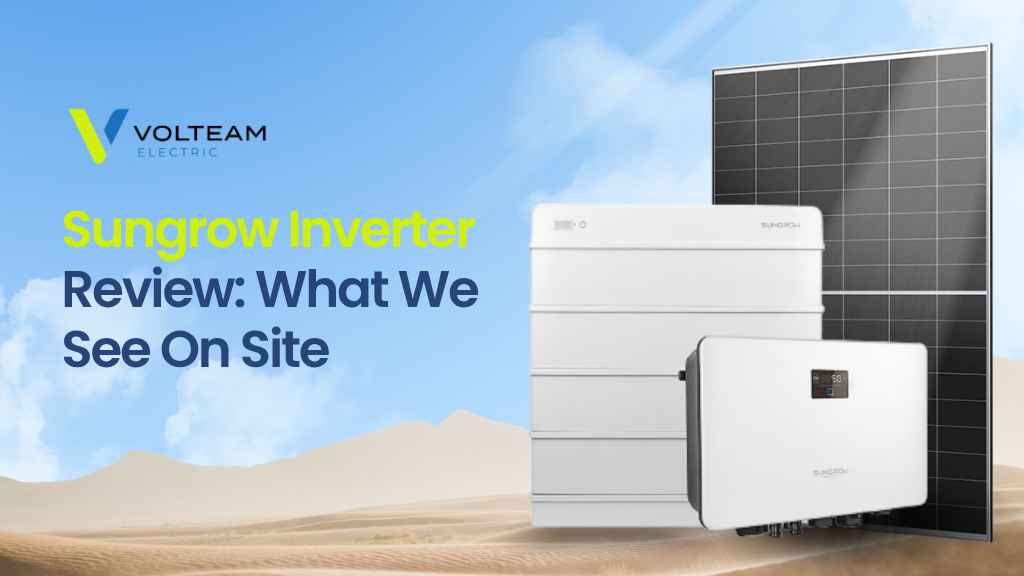
Sungrow Inverter Review: What We See On Site
Sungrow is one of the largest solar inverter manufacturers in the world, and in Australia, it has held the best-selling residential inverter spot for three years running. That scale is part of why it’s the brand we get asked about most and the one we install most.
Volteam sells two different Sungrow inverter families under this same brand name, and mixing them up is the single most common source of confusion we hear from homeowners doing their own research.
This Sungrow inverter review helps you know which is which and, crucially, which one is right for you: the Sungrow SH-series hybrid, or the SG-series CX string inverters. We explore efficiency, backup behaviour, and what actually shows up on an install day.
Sungrow Inverters: Models, Efficiency & Real-World Performance
- Sungrow sells two separate inverter ranges through Volteam: the SH-series hybrid and the SG-series CX string inverters.
- The SH-series inverters are battery-ready, three-phase, and built for homes and small commercial sites.
- The Sungrow SG inverters are larger, non-hybrid, and aimed at bigger solar arrays and commercial roofs.
- Sungrow was named Australia’s number one inverter manufacturer by SunWiz for 2024, and has held the top-selling residential inverter spot in Australia for three years running.
- Maximum efficiency across the range sits at 98.6% to 98.7%, verified against Sungrow’s own published datasheets, not just Volteam’s on-page copy.
- The hybrid SH10T switches to backup power in around 10 milliseconds and accepts battery voltages from 100V to 700V, which is why it pairs cleanly with Sungrow’s own SBR battery.
- Every current model carries a 10-year parts and labour warranty, and Australia is one of the only markets where that full term applies as standard rather than as a paid extension.
- On real roofs, the string in a Sungrow inverter matters more to yield than the brand name does, so we cover how installers should approach that decision below.
What are the two Sungrow Inverters?
If you’ve looked at Sungrow inverters and felt like the numbers did not quite line up, that is because you were probably comparing two different products without realising it.
- The Sungrow SH10T hybrid inverter is a 10kW, three-phase unit built for houses and small commercial sites that want solar, storage, and backup power in one box. It has two MPPTs, accepts battery voltages between 100V and 700V, and is designed to work as a plug-and-play pairing with a Sungrow battery.
- The Sungrow SG-series string inverters, sold as the SG33CX, SG40CX, and SG50CX, are a different animal entirely. These are non-hybrid string inverters rated from 33kW up to 50kW, with three to five MPPTs depending on the model, built for larger residential arrays and commercial roofs rather than a typical suburban home with a battery.
If your household is chasing blackout protection and a battery pairing, the hybrid SH10T is almost always the right conversation to start. If you are fitting out a large commercial roof or a bigger array without a battery attached, the SG-series string inverters are the ones doing the heavy lifting. Knowing which range you are actually looking at before you start comparing prices or specs saves a lot of confusion later.
Who is Best Suited to a Sungrow Inverter?
The SH10T hybrid suits a household or small commercial site that wants a battery in the mix, whether immediately or at a later point. It’s built for backup power, and its 100V–700V window is wide enough to pair with Sungrow’s own SBR battery or most other high-voltage packs on the market. If blackout protection is the reason you’re looking at Sungrow at all, this is the range to start with.
The SG-series string inverters suit the opposite case: a larger residential array or a commercial roof with no battery attached. Without a battery to configure, installation is more straightforward, and the higher MPPT counts on the bigger models matter more than they would on a typical single-orientation home roof.
How Efficient is a Sungrow Inverter?
Every Sungrow spec sheet leads with efficiency, and for once the number holds up. Sungrow’s own published datasheets put maximum efficiency for the SG33CX, SG40CX, and SG50CX at 98.6% to 98.7%, with the exact figure depending on the model. That is a genuinely competitive number against the other brands we install, and it means very little of the energy your panels generate is lost in the conversion from DC to AC.
What the spec sheet does not tell you is how much of that theoretical efficiency you actually see. In practice, MPPT count matters more than the headline efficiency figure once your roof has more than one orientation. A string inverter with three MPPTs can track three independently shaded or angled roof sections, which is common on the hip roofs and multi-storey homes we see across Brisbane. Fewer MPPTs than your roof has orientations means one section is dragging the whole string’s output down to match its worst performer, which is a far bigger loss than the difference between 98.6% and 98.7% efficiency.
Bifacial module compatibility is worth mentioning too, since it is on every model in the range. It only pays off if you are actually running bifacial panels, which is still uncommon on a standard residential roof but increasingly common on ground-mount and larger commercial arrays where the extra yield from reflected light justifies the panel cost.
Backup Power: How the Hybrid Handles a Blackout
The SH10T’s backup switching is genuinely one of the better features in this price bracket. Sungrow rates the transition at around 10 milliseconds, fast enough that most household electronics do not register the interruption at all. Fridges keep running, routers stay connected, and anything without its own internal battery does not need to reboot.
Where this becomes a practical decision rather than a spec number is peak load. The SH10T can push a peak backup output of close to 15kW for around 10 seconds, which covers the surge from things like a pool pump or an air conditioning compressor kicking in. If your household regularly runs several high-draw appliances at once during an outage, that peak headroom is what stops the system from tripping out when you least want it to. A smaller single-phase household running a few essential circuits during a blackout will rarely get close to that ceiling, but a larger three-phase home juggling a pool filter and a ducted system on the same afternoon absolutely can.
Battery compatibility on the SH10T runs from 100V to 700V, which is a wide enough window to work with Sungrow’s own SBR battery as well as most other high-voltage battery packs on the market. That flexibility is one reason we default to the hybrid range whenever a battery is part of the conversation, rather than adding a separate hybrid box to a string inverter setup after the fact.
Build Quality and What We Notice On Install Day
IP66 protection and a C5 anti-corrosion rating on the SG-series is a genuinely useful spec for coastal or semi-coastal Brisbane properties, where salt air chews through cheaper enclosures faster than most homeowners expect. The hybrid SH10T carries an IP65 rating, still solid for both indoor and outdoor mounting, though marginally less sealed than the SG-series.
Noise is the one area where Sungrow is not the quietest brand we install. Under moderate to heavy load, the internal fan on both ranges is audible, more so than some of the fully passive-cooled alternatives on the market. It is not loud by any reasonable measure, but if the mounting wall backs onto a bedroom or a home office, raise it with your installer before the day of the job, not after the fan is already running.
On the installation side, the SH10T’s plug-and-play design genuinely does cut time on site compared with older hybrid units we have worked with, and its Arc Fault Circuit Interrupter and integrated surge protection reduce the amount of additional protective gear needed in the switchboard. The SG-series units are more straightforward again, since without a battery to configure, there are fewer commissioning steps to work through.
Sungrow Inverter Specifications
| Spec | SH10T Hybrid | SG33CX / SG40CX / SG50CX |
| Type | Three-phase hybrid, battery-ready | Three-phase string, non-hybrid |
| AC Output | 10kW | 33kW / 40kW / 50kW |
| MPPTs | 2 | 3 / 4 / 5 |
| Maximum Efficiency | Not published as a standalone figure by Sungrow | 98.6% to 98.7% |
| Battery Voltage Range | 100V to 700V | Not applicable, no battery input |
| Backup Switch Time | Approximately 10ms | Not applicable, non-hybrid |
| Protection Rating | IP65 | IP66, C5 anti-corrosion |
| Oversizing | Up to 200% (20kW of panels) | Model dependent |
| Warranty | 10 year parts and labour | 10 year parts and labour |
| Best Suited To | Homes and small commercial sites wanting battery backup | Larger residential arrays and commercial roofs |
How It Compares
Sungrow is not the only brand we install, and it is worth knowing where it sits against the alternatives before you commit either way.
- Against Fronius, the comparison usually comes down to backup switching speed versus a longer local service history in Australia. We have written a full breakdown in Fronius vs Sungrow: Which Solar Inverter Reigns Supreme if you want the detailed side-by-side.
- Against GoodWe, the gap is smaller than either brand’s marketing suggests. Both sit in a similar price bracket, and the GoodWe inverter range tends to win out for households that want the widest range of capacity options in one product family.
- Against Sigenergy, the newer Sigenergy hybrid inverter leans harder into app-based energy management and virtual power plant participation, which suits households that want to actively trade stored energy rather than simply use it as backup.
If you want the fundamentals of how any of these inverters actually work before comparing brands, our guide on how solar inverters work is a useful starting point.
The Verdict: Is Sungrow Worth It?
- If a battery and backup power are part of your plan, the SH10T hybrid is almost always the right starting point.
- But if you’re fitting a larger array with no battery attached, go for the SG-series string range.
In each case, confirm that a Sungrow inverter works on your own roof rather than guessing from a spec sheet. Volteam’s installers assess your orientation, panel count and backup needs on-site, then recommend the range that actually fits.
Whichever Sungrow inverter fits your situation, the decision comes down to whether a battery and backup power are part of your plan. If they are, start with the Sungrow hybrid inverter page. If you are planning a larger array without storage, the Sungrow string inverter range is the better starting point.
For a straight answer on which one suits your roof, get a free quote from our team, or browse the full range in our shop.
Frequently Asked Questions
What is the difference between the Sungrow SH-series and SG-series inverters?
The SH-series, including the SH10T, is a hybrid inverter built to work with a battery and provide backup power during an outage. The SG-series, including the SG33CX, SG40CX, and SG50CX, is a non-hybrid string inverter built for larger solar arrays without a battery attached. They are not interchangeable products, and Volteam sells both under the Sungrow name.
Can a Sungrow string inverter be upgraded with a battery later?
Not directly. The SG-series string inverters have no battery input, so adding storage later means fitting a separate hybrid unit or an AC-coupled battery box next to the existing string inverter, rather than plugging a battery straight into it. If you think a battery is likely in your future, it is worth starting the conversation about a hybrid inverter now rather than retrofitting later.
How noisy is a Sungrow inverter during operation?
Under moderate to heavy load, the cooling fan on both ranges is audible from close range, more so than some fully passive-cooled competitors. It is within normal operating limits for the product, but we factor mounting location into the site visit for households that are sensitive to it, particularly if the inverter has to sit near a bedroom or home office wall.
Does the Sungrow hybrid inverter work without an internet connection?
The inverter itself will continue converting solar and managing backup switching without an internet connection. Remote monitoring, firmware updates, and app-based control through Sungrow’s iSolarCloud platform do require connectivity, so you lose visibility and remote management during an outage, not the core function of the inverter.
Is a Sungrow inverter compatible with solar panels from other brands?
Yes. Sungrow inverters are not locked to Sungrow panels and work with the panel brands we install, including Jinko, Trina, Aiko, REC, Longi, and Canadian Solar, provided the string configuration and voltage windows suit the panel specifications.
How many inverters can be installed in parallel on a larger system?
The SH10T supports parallel installation of multiple units for larger systems, which is a common approach for bigger residential or light commercial sites that need more capacity than a single unit provides rather than stepping straight up to the larger SG-series string inverters.