

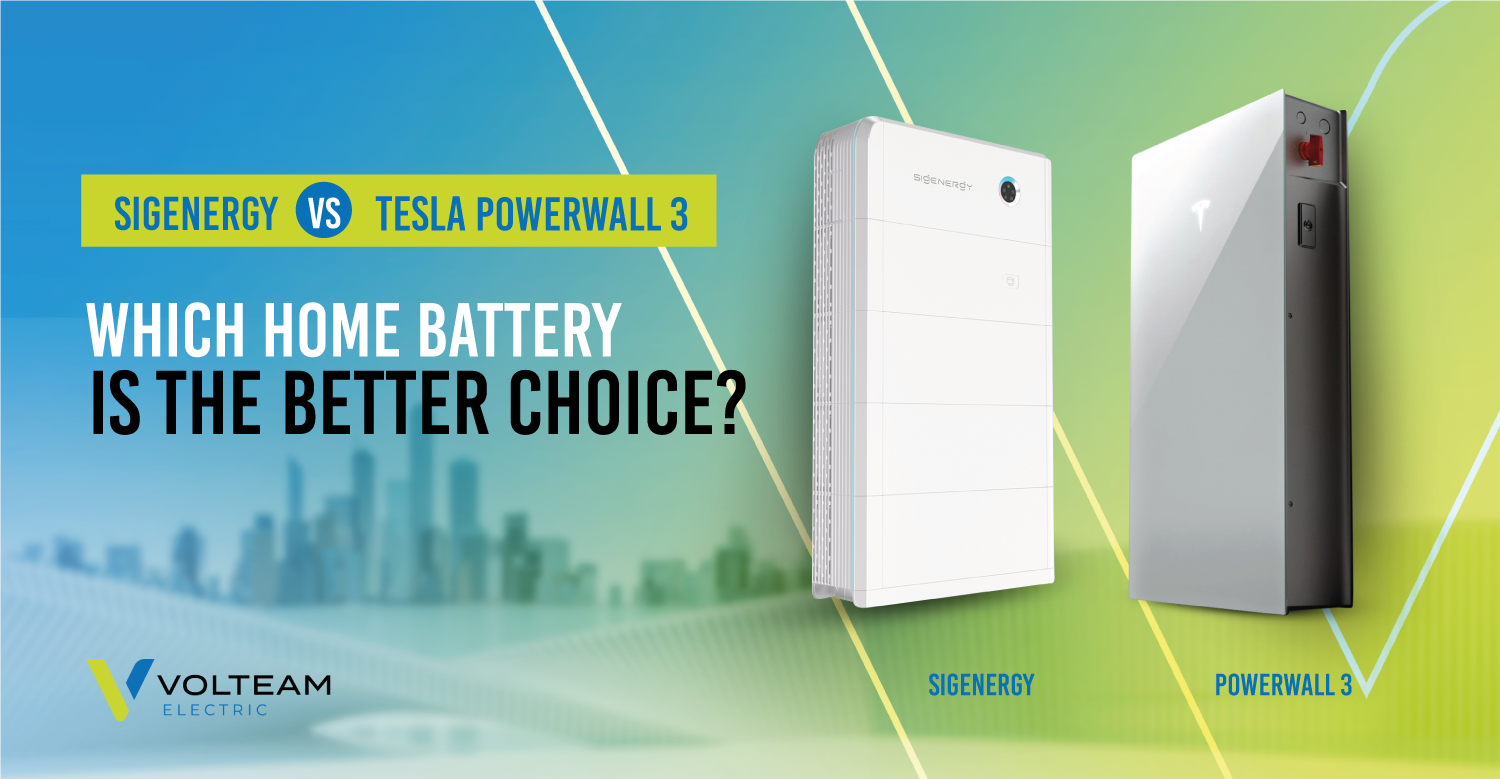
Sigenergy vs Tesla Powerwall 3: Which Home Battery Is the Better Choice?
Sigenergy and Tesla are two top manufacturers when it comes to solar batteries for your home. Both brands offer innovative features and exceptional performance, making it challenging to choose between them.
Choosing the right brand comes down to performance, flexibility, and value for money. While the Tesla Powerwall 3 is slick, powerful, and integrated for setting up from scratch, the Sigenergy Sigenstor is flexible, modular, and can fit into bespoke setups.
In this article, we’ll break down the differences between Sigenergy and Tesla’s solar battery offerings and determine which is the best choice to match your needs.
Comparison Table: Sigenergy Sigenstor vs Tesla Powerwall 3
To give you an overview of what each brand has to offer, here’s our comparison table of Signeregy vs Tesla.
| Feature | Sigenergy Sigenstor | Tesla Powerwall 3 |
| Storage capacity | 5kWh or 8kWh units | 13.5kWh |
| Efficiency | DC-coupled round-trip 98%AC-coupled round-trip 90% | DC-coupled round-trip 97.5%AC-coupled round-trip 90% |
| Safety features | Advanced thermal managementOvercharge protectionInternal fire extinguishing system | Standard safety systems |
| Compatibility | Works with all inverters and solar systems | Works with all inverters and solar systems (does not provide blackout functionality for existing three-phase solar systems) |
| Scalability | Multiple stacks and controllersHighly scalable for large homes | Up to 4 Powerwalls + 3 expansion packs |
| Ingress Rating | IP66 (suitable for outdoor) | IP55 enclosureIP67 battery and power enclosure |
| Warranty | 10 years60% capacity or throughput | 10 yearsUnlimited cycles80% capacity |
| App & eco-system | mySigen appOptional integrated DC EV-charger module | Tesla appStorm WatchTime-based controlEV charge |
Sigenergy vs Tesla Powerwall 3: Performance and Storage Capacity
A solar home battery must have sufficient energy stored to keep your household running efficiently in various scenarios. This can include using stored energy during peak hours, at night-time, and to power your home during a blackout.
The Sigenergy Sigenstor has a modular design and can be expanded in increments of 5kWh or 8kWh units as needed. This makes it easy to scale up if your energy needs increase. Because of this, solar installers like to use this brand for creating bespoke systems.
Meanwhile, the Tesla Powerwall 3 has a fixed capacity of 13.5kWh per unit. You can increase capacity, but only at this amount, making it less flexible.
Sigenergy vs Tesla Powerwall 3: Home Backup
One of the central capabilities that homeowners have in mind with solar battery storage is the ability to power their home during a power cut.
The Tesla Powerwall 3 features a backup system through the Tesla Gateway (an optional add-on), which provides whole-home backup and can automatically isolate from the grid during power outages. It also offers real-time monitoring and load management.
The Tesla Gateway is no longer a mandatory purchase when considering the Powerwall 3, which can alter the cost. However, you can still have a Tesla Gateway retrofitted at a later date if you change your mind.
The single-phase design of the Powerwall 3 means it works best in a single-phase home. Although it can be installed in a three-phase home, it will only be able to back up one of the three phases. This means more inverters at a higher cost.
Sigenergy also provides backup through an optional add-on known as the Sigen Energy gateway, which can be installed alongside the Sigenstor or added later on.
The Sigenstor stands out for its ability to support a 3-phase supply, in contrast to the single-phase capability of the Tesla Gateway. If you’re no stranger to frequent blackouts, the Sigenstor can be a great option for its integration with generators.
Sigenergy vs Tesla Powerwall 3: Value for Money
The upfront cost for battery systems represents a long-term investment for lowering energy bills, achieving energy independence from the grid, and maximising the potential of your solar energy system.
Opting for a cheaper brand may result in a lower initial expense, but it can ultimately drive down the long-term value and lead to higher costs in the future.
Alongside installation and factoring in rebates, the Tesla Powerwall 3 costs approximately $15,000 for a retrofit or $21,000 for a new solar power system.
On the other hand, the Sigenstor comes in at around $21,000 for a 16kWh system. The flexibility of the Sigenstor allows you to adjust the cost according to your energy needs, and your final price can vary depending on factors such as battery size, inverter capacity, and whether your home is single-phase or 3-phase.
Sigenergy vs Tesla Powerwall 3 Overview
Based on the facts, there are several ways to make an informed decision about your solar battery choice.
The Tesla Powerwall 3 offers a sleek and simple experience, featuring premium build quality, intelligent software, and intuitive monitoring through your app. It’s all integrated and polished, meaning it’s meant to run quietly in the background as a low-maintenance yet premium system where you can set it up and not think about it too much if you don’t want to.
The Sigenergy Sigenstor is ideal for those who want flexibility and control. While Tesla has a more universal approach, the Sigenstor is highly adaptive and designed to work with real homes that have complex systems, allowing for easy expansion in the future. The advanced gateway features, compatibility with multiple brands, size options, and flexibility in cost-per-kWh, are great for bespoke systems.
If you’re interested in maximising your solar power potential, contact Volteam for a premium solar battery installation. We can help you pick the right system for your needs and install it in line with Australian standards. Our solar experts can provide a comprehensive site visit to ensure that your system is installed in an optimal location, and we’re here to help you maintain it in top condition for years to come.