

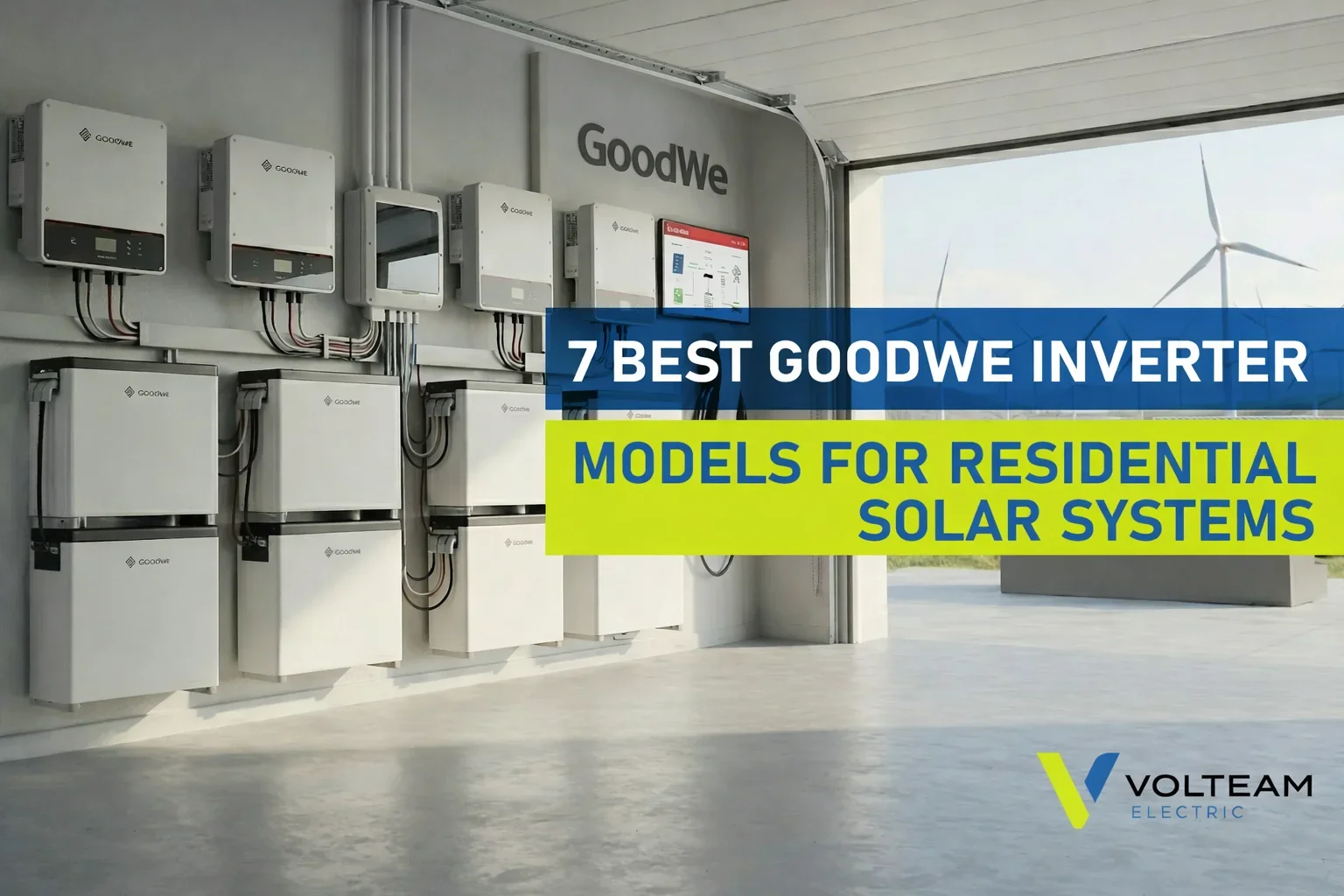
7 Best GoodWe Inverter Models for Residential Solar Systems
Hybrid solar is booming in Australia because it solves a real homeowner problem, where you can use more of your own solar instead of exporting it for a low feed-in rate and buying it back later at peak pricing.
Now, the heart of any hybrid setup is the inverter, because it controls how the battery and the grid work together minute by minute. But more specifically, today, we’ll be looking at GoodWe inverter models.
Problem is, a lot of the inverters out there price people out of using them, so if you’re mid-range pricing without giving up the essentials – solid efficiency, practical monitoring, battery readiness, compliance – GoodWe sits in that “value-with-features” sweet spot.
Below are the models we see make the most sense for homes (and small businesses), depending on everything from your phase supply and roof complexity to whether you’re adding a battery now or later.
CTA: If you want help comparing models to your actual usage (single vs three-phase, export limits, battery sizing), we can run a free inverter match-up and recommend the simplest option for you.
What is a GoodWe inverter?
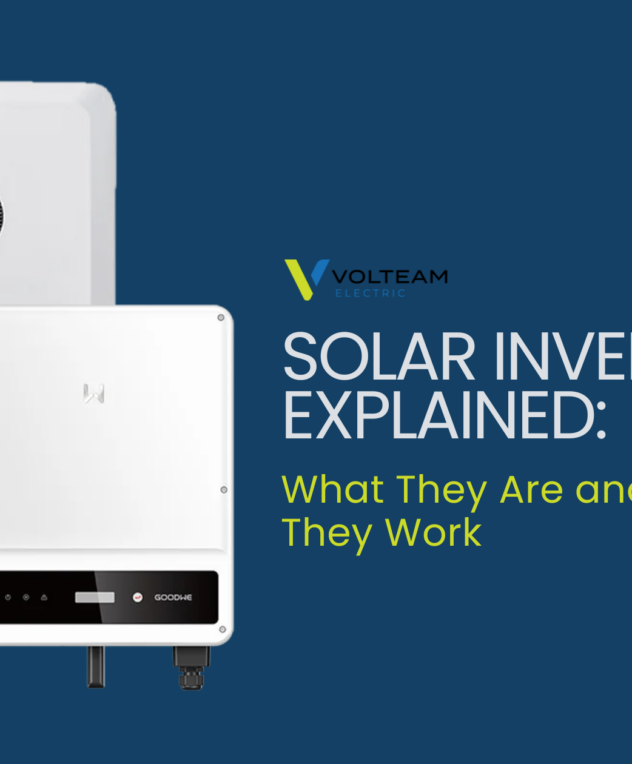
A GoodWe inverter converts the DC electricity that your solar panels make into usable AC power for your home. But in hybrid models, it also controls battery charging/discharging and can even provide backup power (when the system is designed with backup circuits).
In Australia, you’ve got to think about compliance as much as you do specs when you’re picking an inverter. Fortunately, though, the Clean Energy Council (CEC) approved inverter list, which is the key reference used across rebate programs and by most networks, includes GoodWe models. So it gets extra points from us there.
You can easily see GoodWe’s local AU/NZ warranty terms – they’re also updated regularly, which we like because it gives buyers clarity before purchase.
GoodWe Inverter Models Overview
Let’s look at the GoodWe models/series we commonly recommend for GoodWe solar inverter (Australia) options:
Model / Series | Type | Phase | Typical Use Case | Notable Specs |
DNS G4 (3-6kW) | Grid-tied string | 1 | Budget-friendly homes or straightforward rooftops | Designed for 2 MPPTs and high PV oversizing capability (series-level feature set). |
DNS (AU) (3-5kW) | Grid-tied string | 1 | Value solar upgrades/replacements | Max efficiency 97.8%. |
MS / MS G3 (5-10kW) | Grid-tied string | 1 | Complex roofs (multiple orientations), higher solar | 3 MPPTs; low start-up voltage |
SDT G2 (5-20kW) | Grid-tied string | 3 | Three-phase homes and small businesses | Max efficiency 98.4%. |
ES (5kW) | Hybrid (LV battery) | 1 | Battery-ready and backup-capable designs | Max efficiency 97.6%. |
ES G2 (3-6kW) | Hybrid (LV battery) | 1 | New hybrid installs, flexible battery options | UPS-level switch to backup in <10ms |
EH (3.6-6kW) | Hybrid-ready (HV battery) | 1 | High-voltage battery systems, fast backup switching | Max efficiency 97.6% |
ET G2 (6-15kW) | Hybrid (HV battery) | 3 | Three-phase hybrid and larger homes | Max efficiency up to 98.2% (varies by model) |
SBP (5kW) | AC-coupled retrofit (LV battery) | 1 (retrofit works with ⅓ phase PV systems) | Add battery backup to an existing solar system | Max efficiency 95.5% |
- No battery planned? We’d suggest starting with DNS/MS (single-phase) or SDT G2 (three-phase).
- Battery later (but want hybrid-ready now)? ES/ES G2 (LV) or EH (HV), depending on your battery type and system goals.
- Three-phase and battery? ET G2 is usually where we start.
GoodWe Inverter Price Guide
If we’re assuming a standard compliant install (including isolation, protections, commissioning, monitoring setup), these are generally our typical installed ranges you’ll see in our day-to-day quoting for residential installs:
- Single-phase string (DNS / MS): this one’s typically the most budget-friendly option
- Three-phase string (SDT G2): higher hardware plus more complex labour on account of the three phases
- Hybrid (ES/ES G2/EH/ET G2): higher again because you’re paying for bidirectional battery control and extra metering/CTs
- Retrofit battery inverter (SBP): this is generally more cost-effective if you already have a solid string inverter and just want some storage/backup added
What Changes the Final Cost?
- Phase supply (single vs three-phase): three-phase hardware and commissioning is usually more involved.
- Roof complexity and string design: multiple orientations/shading can push you toward MS (3 MPPT) which reduces clipping and improves yield.
- Battery compatibility (LV vs HV): ES/ES G2 are more LV-focused, while EH/ET target HV battery setups.
- Backup circuits: essential load board and compliance testing do add costs, but they massively improve resilience, which we think is a worthy trade-off.
Performance and Efficiency
How do those seven models we mentioned in GoodWe’s residential range hold up? Across the board. They’re all generally pretty efficient for mid-range buyers, but here are the specifics for our GoodWe hybrid inverter review:
- DNS (AU): max efficiency 97.8%
- MS series: built for complex rooftops with 3 MPPTs (which is helpful when panels face different directions)
- SDT G2 (AU): max efficiency 98.4%
- ES (AU): max efficiency 97.6%
- EH (HV hybrid ready): max efficiency 97.6%
- ET G2 (HV hybrid, three-phase): max efficiency up to 98.2%
- SBP retrofit: max efficiency 95.5%
So, GoodWe vs premium inverters – which should you choose? Realistically, for most homeowners, you’ll be better off spending extra on a premium inverter if you’re building a high-complexity system (multiple roofs, EV integration, big battery stack, future expansion).
Otherwise, the GoodWe models we’ve chosen are definitely the more practical pick when designed properly, which our team at Volteam can ensure.
Who Should Choose GoodWe?
1. Budget-friendly buyers
If you’re comparing dollars per kilowatt without sacrificing compliance, GoodWe’s DNS/MS and SDT families are some of the more common picks for straightforward grid-tied systems.
2. Battery-ready solar users
If a battery is on the roadmap, we’d generally suggest picking a hybrid-capable architecture now rather than swapping inverters later. It’s a lot more affordable and time-saving. ES/ES G2 (LV) and EH/ET (HV) cover most residential hybrid needs.
3. Small business installations
For three-phase sites that want solar first (and storage later), SDT G2 is a pretty decent starting point. But for three-phase solar plus storage, ET G2 is the more natural hybrid step-up.
Installation Case Study
So, how might a GoodWe hybrid setup perform in your average home? We’ve put together an example for a household with higher evening usage:
Scenario:
- Home: three-bedroom household, weekday evening peak loads (cooking, lighting, TV, Wi-Fi, occasional aircon)
- System: ~6.6kW solar + 5kW single-phase hybrid GoodWe inverter + ~10kWh battery
- Goal: ‘We want to reduce our evening grid imports and keep essential circuits running during outages”
What You Can Reasonably Expect
Average daily solar generation: this would be around 18-28 kWh/day across a month. Depending on the season and location, of course
- Self-consumption: would be about 60-85% when a battery is correctly sized and the household has meaningful evening loads
- Grid imports: these are commonly reduced by 40-70% compared to a solar-only system or pre-solar baseline. Again, depending on tariff and your usage habits
- Backup behaviour: when the system includes an essential-loads circuit, any hybrid inverter that’s designed for backup should be able to switch supply quickly enough that most your devices (lights, internet, fridge) keep running without any noticeable interruptions
Why Choose Volteam
Here’s what we do differently at Volteam:
- Hybrid system expertise: we design around your load profile rather than just the amount of panels you have.
- Correct inverter sizing: this is how we avoid unnecessary clipping or annoying shutdowns
- After-sales support: we don’t disappear after install – monitoring setup, optimisation help if your needs change.
And aside from those, you’ll be glad to know that we stick to compliant, rebate-eligible product pathways.
CTA: Want a straight answer on which GoodWe model fits your home? Reach out for a free consultation, and we’ll compare options (string vs hybrid vs retrofit) based on your bills and goals.
Frequently Asked Questions
Is a GoodWe inverter approved for use in Australia?
Many GoodWe models are listed on the Clean Energy Council-approved inverters list, which is used widely across Australian solar programs and by networks.
What’s the warranty on a GoodWe inverter?
GoodWe publishes all their AU/NZ warranty terms, but keep in mind that coverage can vary by product line and conditions. So make sure you always check the current warranty document for your exact model and install date.
Which is better for batteries: ES/ES G2 or EH/ET?
ES/ES G2 are mainly used with low-voltage batteries, while EH/ET families are designed around high-voltage battery architectures. So realistically, the right answer will depend on your battery choice and phase supply – even whether you need a three-phase hybrid or not.
Can I add a battery to an existing solar system without replacing my inverter?
Often yes, and we’d be happy to sort it for you. An AC-coupled retrofit option, like GoodWe’s SBP series, for instance, are designed to add battery storage/backup to an existing PV system.
Ready to install?
Reach out to Volteam for a free consultation – we’ll help you compare all the suitable GoodWe inverter models and design a system that actually fits your home. Get in touch today!